A CDN alternative to AWS CloudFront is a content delivery network service that replicates the edge caching and global distribution capabilities of CloudFront without requiring an AWS account or AWS-native pricing and configuration model.
For teams with traffic outside the AWS infrastructure footprint, evaluating a content delivery network (CDN) alternative is a routine architectural decision. The criteria are consistent across most use cases: cache-hit ratio, egress cost model, point of presence (PoP) coverage, and whether a web application firewall (WAF) is bundled at the tier you need. Providers including Cloudflare, Fastly, BunnyCDN, and KeyCDN each occupy a different position on that cost-versus-capability axis. The decision turns on which tradeoffs your architecture can absorb.
What AWS CloudFront Provides and Why Teams Look for Alternatives
AWS CloudFront is a global edge caching service that integrates tightly with S3, EC2, and Lambda@Edge, but its per-request pricing model and AWS account dependency lead teams outside the AWS ecosystem to evaluate CDN alternatives. CloudFront operates across a global edge network spanning 750+ PoPs in 100+ cities across 50+ countries, giving it one of the densest coverage maps in the content delivery network market. For teams already running workloads on AWS, those integrations are compelling. For teams on other infrastructure, the overhead of an AWS account, IAM policies, and CloudFront-specific configuration syntax often outweighs the performance benefit. The how content delivery networks accelerate web delivery explainer covers CDN fundamentals in detail.
Four recurring reasons lead teams to look beyond CloudFront:
- Egress cost and per-request charges: CloudFront bills per HTTPS request and per GB transferred out to the internet. At scale, those two line items compound quickly for high-traffic sites without AWS infrastructure absorbing the inter-service transfer.
- Ecosystem lock-in: CloudFront's deepest capabilities, including Lambda@Edge, CloudFront Functions, and S3 origin integration via Origin Access Control, require operating other AWS services. A team that moves off S3 loses a core CloudFront advantage.
- Configuration complexity: Cache behavior rules, origin groups, and invalidation logic carry a steeper learning curve than most competing providers. Operators unfamiliar with the AWS console often spend disproportionate time on distribution setup and debugging.
- Support and tooling cost thresholds: Several alternative providers offer purpose-built dashboards, real-time analytics, and paid support at cost thresholds below AWS Support plan levels. For smaller teams, that gap matters.
Core Criteria for Evaluating a CDN Alternative
A CDN alternative earns its place only when it matches CloudFront on the metrics that directly affect end-user experience: cache-hit ratio, Time to First Byte, global PoP coverage, and origin shield availability. Evaluating vendors on list pricing alone misses the operational picture. The five criteria below determine whether a provider performs at parity with CloudFront for your specific traffic profile.
- Cache-hit ratio
- The percentage of requests served from edge nodes without hitting the origin server. Higher ratios reduce origin load and egress cost simultaneously. Vendor-reported ratios reflect aggregate network behavior; your actual ratio depends on your asset mix between static files and dynamic or personalized content. Measure it after configuration, not before.
- Time to First Byte (TTFB)
- The latency between the browser sending a request and receiving the first byte of the response, measured via the
responseStartvalue in the browser's Navigation Timing API. TTFB is governed primarily by PoP density relative to your audience geography. A replacement CDN with fewer point of presence nodes concentrated in North America and Europe will show higher TTFB for Asia-Pacific and Latin America traffic than a provider with denser global coverage. - Origin shield
- An intermediate caching tier positioned between edge nodes and the origin server that collapses redundant cache-miss requests into a single upstream fetch. Not all providers include origin shield on lower-cost tiers. For origin servers with limited concurrency or expensive query paths behind each cache miss, its absence at a given plan tier is a meaningful operational constraint.
- Egress cost model
- Providers use three main pricing structures: flat-rate per-GB tiers, included-bandwidth plans, or pay-as-you-go metering. The structure that minimizes your monthly bill depends on your actual traffic volume and distribution across regions. Do not evaluate egress cost from list prices; run your last three months of bandwidth data through each vendor's public pricing calculator before committing.
- WAF and DDoS integration
- Some providers bundle a web application firewall and volumetric DDoS protection at all plan tiers. Others charge separately or require a third-party WAF vendor. If your current CloudFront setup relies on AWS WAF rules, factor the WAF replacement cost into the total comparison, not just the CDN egress line.
Comparing Leading CDN Alternatives to AWS CloudFront
CDN alternatives including Cloudflare, Fastly, BunnyCDN, and KeyCDN each occupy a distinct position on the cost-versus-capability spectrum that CloudFront does not cover uniformly. The comparison below summarizes PoP coverage, origin shield availability, WAF inclusion, pricing model, and best-fit scenario for each provider. Prices are from each company's pricing page as of October 2026, and they change with network expansions and plan restructuring.
| CDN Provider | PoP Coverage | Origin Shield | WAF Included | Pricing Model | Best Fit |
|---|---|---|---|---|---|
| AWS CloudFront | 750+ PoPs in 100+ cities across 50+ countries | Yes, via CloudFront Origin Shield (AWS docs; additional cost) | Yes, via AWS WAF (additional cost) | Pay-as-you-go per request plus egress (pricing page) | AWS-native stacks, Lambda@Edge use cases |
| Cloudflare | 348 cities | Yes, via Smart Shield, which includes Smart Tiered Cache and Argo Smart Routing | Yes, Cloudflare WAF on all plans including free | Free tier; Pro $20/mo billed annually ($25 monthly), Business $200/mo billed annually ($250 monthly) (Cloudflare plans) | Sites prioritizing WAF and DDoS on a predictable flat plan |
| Fastly | Fewer, larger PoPs with 622 Tbps of capacity as of June 30, 2026, per Fastly's network map | Yes, via Fastly shielding | Yes, Next-Gen WAF available as add-on, priced through Fastly sales | Pay-as-you-go bandwidth plus requests: first 100 GB and 1 million requests free, then from $0.12/GB in North America and Europe (Fastly pricing) | High-traffic publishers needing Varnish VCL cache control |
| BunnyCDN | 119 PoPs globally | Yes, via Origin Shield | Yes, via Bunny Shield: Basic tier free, Advanced $9.50/mo, Business $99/mo | Per-GB by region, from $0.01/GB in Europe and North America; $1 monthly minimum (Bunny CDN pricing) | Budget-conscious teams with high-bandwidth static asset delivery |
| KeyCDN | 60+ data centers across 40+ countries | Yes, Origin Shield, free for all customers | No native WAF | Pay-as-you-go per GB, from $0.04/GB for the first 10 TB in North America and Europe (KeyCDN pricing) | Developers needing HTTP/2 push and real-time analytics without enterprise overhead |
The absence of a native WAF at KeyCDN is not a disqualifier for every team, but it requires a separate DDoS and WAF vendor to reach the security posture that Cloudflare, CloudFront with AWS WAF, or BunnyCDN with Bunny Shield provides at the CDN layer. Factor that into total cost of ownership, not just the egress line.
Choosing the Right CDN Alternative for Your Use Case
Selecting a CDN alternative to AWS CloudFront depends on three interacting variables: your origin server location, your audience geography, and whether your traffic profile is static-asset-heavy or API-driven with high cache-bypass rates. A content delivery network that performs well for a media publisher serving large video files from a single US origin may perform poorly for a SaaS product with API endpoints that bypass caching entirely. Work through these four steps before shortlisting vendors.
- Map your audience geography to PoP coverage. Pull your analytics top-country breakdown and cross-reference it against each provider's published PoP map to identify gaps, particularly in Asia-Pacific and Latin America, where CloudFront's 750+ PoP global edge network has historically denser coverage than budget alternatives.
- Classify your asset mix. Static assets including images, JavaScript, CSS bundles, and video segments benefit most from a high cache-hit ratio on edge nodes. API endpoints and personalized content carry structurally low cache-hit ratios and benefit more from origin shield and low-latency origin routing than from raw PoP count.
- Model egress cost against your actual traffic volume. Use each vendor's public pricing calculator with your last three months of bandwidth data as the input. List price per GB is a poor comparison unit because volume tier structures and regional pricing variation differ significantly across providers.
- Test TTFB from your target regions before migrating. Run synthetic latency tests from a monitoring platform such as Catchpoint or ThousandEyes against your shortlisted options. Do not rely on vendor benchmark claims, which typically reflect best-case scenarios from optimal origin and PoP combinations. The how edge computing and cloud computing differ in latency profile article covers the architectural distinctions relevant to this decision.
How to Migrate From AWS CloudFront to a CDN Alternative
Migrating from AWS CloudFront to a new provider follows a predictable sequence: replicate cache behavior rules, validate HTTPS certificate coverage, run parallel traffic against both networks, then cut DNS over when error rates are equivalent. Skipping the parallel-traffic phase is the most common cause of post-cutover incidents.
- Export your current CloudFront distribution configuration. Record all cache behavior rules, origin groups, custom request and response headers, and TTL settings per path pattern. These become the baseline specification for the new provider's configuration. The AWS CloudFront Developer Guide documents each parameter and the distribution model.
- Provision the replacement CDN with equivalent cache behaviors. Recreate matching path patterns, TTL values, and origin settings. Configure origin shield if your origin server has limited concurrency capacity for cache misses. Mismatched TTL values between CloudFront and the replacement produce cache-hit ratio differences that read as performance regression during parallel testing.
- Issue or transfer SSL/TLS certificates. Most providers provision TLS certificates automatically via the ACME protocol, defined in IETF RFC 8555, using certificate authorities such as Let's Encrypt. Confirm that your domain validation method, either DNS or HTTP file-based, is compatible with the new provider's certificate issuance workflow. HTTP caching behavior during the transition follows cache-control directive semantics defined in IETF RFC 9111; confirm your existing cache-control headers will produce the expected behavior under the new service's interpretation.
- Run traffic in parallel using weighted DNS. Point a test CNAME or low-traffic subdomain at the replacement service. Monitor cache-hit ratio, TTFB, and error rates against CloudFront baselines using your existing monitoring platform. Weighted DNS routing lets you gradually increase the traffic share before committing to full cutover.
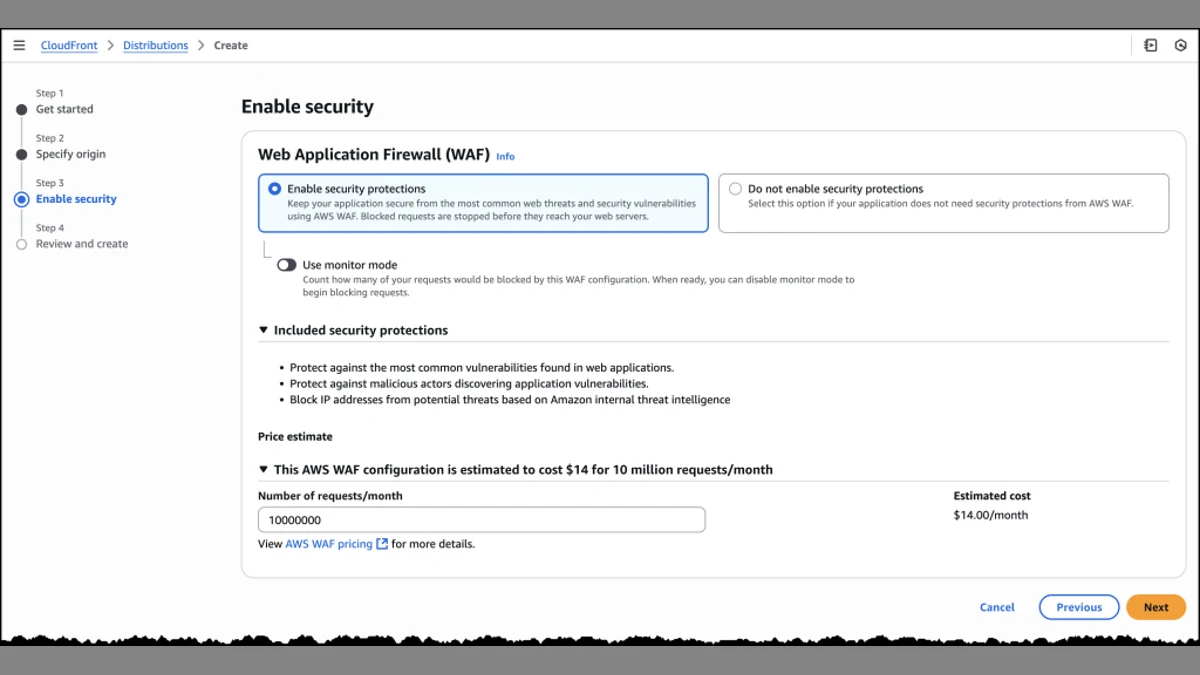
- Validate web application firewall rules before cutover. If your CloudFront setup relies on AWS WAF block and allow rules, replicate those rules in the new provider's WAF before moving production traffic. Untested WAF migration is a recurring cause of post-cutover 403 floods, where legitimate traffic matches migrated block rules that were not validated against production request patterns.
- Execute DNS cutover during a low-traffic window. Update the production CNAME to the new provider's edge hostname. Monitor TTFB and error rates for at least one complete traffic cycle before decommissioning the CloudFront distribution. For Cloudflare-specific migration steps, the configuring Cloudflare as your CDN alternative guide covers the WordPress integration procedure.
When AWS CloudFront Remains the Better Option
Switching makes sense only when the tradeoffs favor it; AWS CloudFront retains a structural advantage for architectures that depend on Lambda@Edge, CloudFront Functions, or tight integration with S3 and API Gateway. Security baseline guidance for public-facing web servers, including WAF placement and TLS policy, is addressed in NIST SP 800-44 Version 2; that guidance applies regardless of which CDN sits in front of the origin server. Four scenarios favor keeping CloudFront over switching to an alternative provider.
- Lambda@Edge workloads: Request and response manipulation at the edge using AWS Lambda functions is native to CloudFront's global edge network. Most replacement options offer serverless edge function execution, but with different runtime models, cold-start profiles, and geographic availability. Behavioral parity with Lambda@Edge is not guaranteed without explicit testing.
- Private S3 bucket origins without public access: CloudFront serves private S3 content through Origin Access Control without exposing the bucket to the public internet. Replicating this pattern on a different CDN requires custom signed-URL logic or a different origin server architecture. That operational complexity often exceeds the cost savings from switching providers for S3-backed content delivery.
- Multi-origin failover within a single distribution: CloudFront origin groups provide automatic failover between a primary and secondary origin server at the CDN layer, without involving DNS. Most replacement services implement failover at the DNS or load-balancer tier, which introduces additional propagation latency and a different failure boundary.
- AWS Shield Advanced coverage: Teams paying for AWS Shield Advanced gain CloudFront DDoS protection with no additional egress charges within the Shield Advanced scope. Switching to a different provider removes that coverage and requires either a separate DDoS mitigation subscription or reliance on the replacement's bundled protection tier.
The decision is an architecture question: which capabilities your application depends on at the edge, which cost model your traffic volume rewards, and whether your team has the operational bandwidth to manage a migration. Commit to a CDN alternative only after those variables are mapped against the specific provider you plan to run.
Further reading
Frequently Asked Questions
Is Cloudflare a direct replacement for AWS CloudFront?
Cloudflare replicates most of CloudFront's core capabilities: global edge caching, HTTPS termination, DDoS protection, and a web application firewall. It does not replicate Lambda@Edge or native S3 Origin Access Control. For sites not using those AWS-native features, Cloudflare is a viable CDN alternative with a simpler configuration model. Compare feature parity against your specific cache behavior rules before migrating.
How do I compare CDN egress pricing without a vendor quote?
Pull your last three months of CloudFront data transfer out metrics from AWS Cost Explorer and use that bandwidth figure as the input to each provider's public pricing calculator. Most publish a calculator on their pricing page. Compare the monthly estimate for your actual volume rather than evaluating per-GB list prices in isolation, because volume discounts vary significantly across providers.
What is an origin shield and do I need it?
An origin shield is an intermediate caching tier positioned between the CDN's edge nodes and your origin server, designed to collapse redundant cache-miss requests into a single fetch. If your origin server has limited concurrency or expensive database queries behind each cache miss, origin shield reduces origin load and egress cost. Sites with mostly static assets and a well-tuned cache-hit ratio above 90% typically see diminishing returns from origin shield.
Can I run AWS CloudFront and a CDN alternative simultaneously during migration?
Yes. The standard approach is to provision the new service on a separate CNAME, route a subset of test traffic using weighted DNS records, and monitor TTFB and error rates in parallel with CloudFront before cutting over the production hostname. Most domain registrars and DNS providers support weighted routing natively. Do not disable CloudFront until at least one full traffic cycle confirms equivalent performance from the replacement.