An enterprise e-commerce platform is a commerce stack that manages high-volume catalogs, multi-site governance, B2B pricing rules, and deep ERP integrations beyond the ceiling of standard SaaS storefronts.
Standard SaaS commerce platforms are designed for speed and accessibility, not for the operational complexity of enterprises running multiple brands, regional regulatory requirements, and procurement-driven buying workflows. When a DTC brand scales past mid-market GMV thresholds and discovers its platform cannot support contract pricing, custom checkout flows, or data-residency mandates, the evaluation of alternatives begins in earnest. The architecture decision made at that point shapes years of infrastructure spend and engineering capacity.
Why Enterprise Commerce Outgrows Standard SaaS
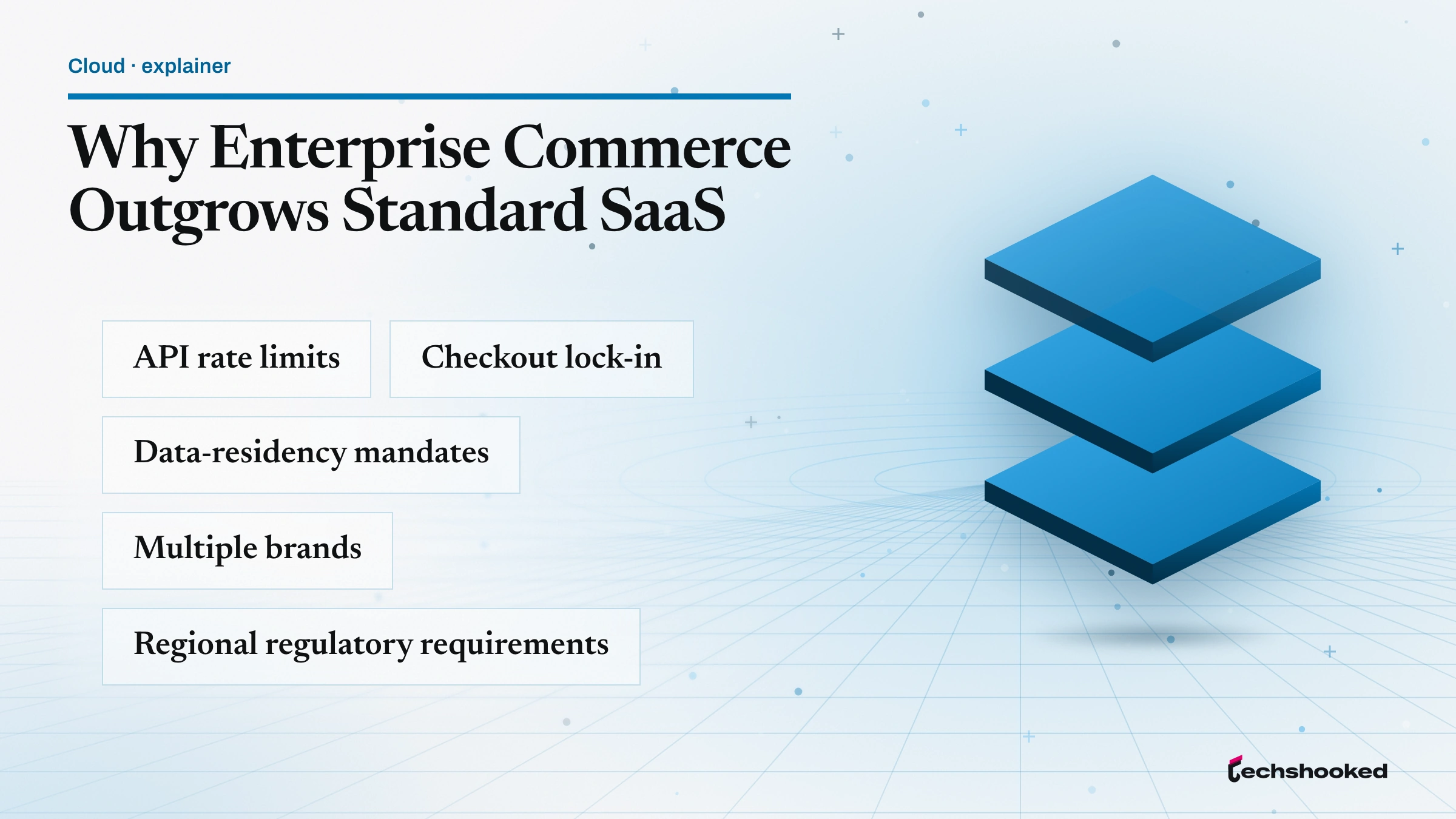
An enterprise e-commerce platform must handle constraints that commodity SaaS tools are not built to address. Shopify Plus, the dominant SaaS commerce option, is engineered for DTC scale and checkout velocity. As organizational complexity grows, several architectural ceilings emerge.
- API rate limits: Multi-tenant SaaS commerce platforms throttle API calls at the infrastructure level. High-frequency catalog updates, ERP sync jobs, and third-party middleware pipelines hit those ceilings during peak trading periods.
- Checkout lock-in: Standard SaaS storefronts restrict how deeply developers can modify the checkout experience. Custom B2B logic, purchase order flows, and split-payment instruments require native extensibility that multi-tenant architectures often cannot provide.
- Multi-tenant constraints: Shared infrastructure means performance is partially a function of neighbor behavior. Dedicated infrastructure or self-hosted environments give enterprises finer control over compute allocation.
- Data-residency requirements: EU General Data Protection Regulation (GDPR) and sector-specific regulations require customer data to remain within defined geographic boundaries. Some SaaS commerce vendors cannot guarantee regional data-residency for all data types.
- B2B catalog complexity: Tiered pricing per buyer account, contract-specific catalogs, quote-to-order workflows, and approval chains do not map cleanly onto SaaS storefront data models built for one-to-many DTC sales.
The building scalable online stores with cloud architecture overview covers the infrastructure patterns that underpin these decisions at the network and compute layer.
Platform Selection Criteria for Enterprise Buyers
Applying structured platform selection criteria before any vendor contract prevents expensive migrations eighteen months later. Enterprise buyers evaluating a new enterprise e-commerce platform should assess seven dimensions: scalability under peak load, native B2B commerce capabilities, checkout control depth, ERP integration model, multi-site management, total cost of ownership (TCO) over a three-year horizon, and data-residency compliance posture.
The table below maps those criteria across the three platforms most frequently shortlisted in enterprise evaluations. Pricing is not included as a flat figure because all three vendors negotiate enterprise contracts; use the vendor pricing pages as a starting reference and request a formal quote for accurate TCO modeling.
| Criterion | Shopify Plus | BigCommerce | Salesforce Commerce Cloud |
|---|---|---|---|
| Scalability | High for DTC; multi-tenant shared infrastructure | High; open API, dedicated infrastructure options | High; cloud-native, Salesforce-managed infra |
| B2B commerce | Shopify B2B module; limited quote workflows | B2B Edition; native quote, ERP, and buyer accounts | Full B2B and B2C storefront separation |
| Checkout control | Checkout Extensibility API; bounded customization | Open checkout; full custom front-end possible | Headless or managed storefront; full control |
| ERP integration | Via third-party connectors and app ecosystem | Open API; native ERP connector ecosystem | Native Salesforce data model; MuleSoft for ERP |
| Multi-site management | Up to 10 stores per Plus account | Multi-storefront on single account | Multi-site natively; region and brand separation |
| TCO model | Flat monthly fee; variable app costs | Tiered revenue-based pricing; lower app dependency | Percentage of gross merchandise volume |
| Data residency | Limited regional options for all data types | US and EU data centers; regional options available | Salesforce hyperforce; multi-region configurable |
Shopify Plus: Strengths and Enterprise Limits
Shopify Plus is the most widely deployed enterprise e-commerce platform for DTC-first brands, and it earns that position through a combination of deployment speed, app ecosystem depth, and storefront performance. Where it struggles is at the intersection of B2B commerce complexity and checkout customization scope.
Strengths that make Shopify Plus the right fit for many organizations include:
- DTC scale and uptime: Shopify Plus handles peak trading events reliably. The platform's managed infrastructure removes DevOps overhead for teams focused on storefront iteration rather than server management.
- App ecosystem: Thousands of vetted integrations cover loyalty programs, subscription billing, personalization engines, and warehouse management without custom development.
- Speed to market: Pre-built themes, a mature Liquid templating system, and Shopify Markets for international expansion reduce time-to-live for new storefronts compared to composable alternatives.
- Checkout Extensibility API: The current checkout customization framework allows developers to inject custom UI components, payment logic, and validation rules, though the extension surface remains bounded by Shopify's sandboxed architecture.
Hard limits that prompt enterprise reassessment include: multi-site management is capped at ten stores per Plus account, which is insufficient for holding companies managing many regional or brand-specific storefronts. Data portability and export granularity are restricted relative to self-hosted or open-API platforms. B2B wholesale workflows requiring quote management and approval chains must be assembled from third-party apps rather than native platform capability. For a direct capability comparison, the Shopify vs BigCommerce for enterprise deployments breakdown covers these gaps in detail.
BigCommerce for High-Volume Enterprise
BigCommerce targets enterprise e-commerce platform buyers who need open API access, native B2B commerce features, and headless commerce front-end flexibility without rebuilding core commerce logic from scratch. Its competitive differentiation rests on four capabilities.
- Open API philosophy: BigCommerce exposes its catalog, checkout, and order management layers through a fully documented REST and GraphQL API surface. Development teams can connect ERP systems, PIM tools, and custom middleware without proprietary connectors or rate-throttling tied to app-store dependencies. Full API documentation is maintained at docs.bigcommerce.com.
- B2B Edition: BigCommerce's B2B commerce edition adds buyer account management, company-level pricing, quote workflows, purchase order acceptance, and approval routing natively. These features address the procurement-side requirements that DTC-oriented platforms handle only through third-party integrations.
- Multi-storefront capability: A single BigCommerce account can operate multiple storefronts, each with independent product catalogs, pricing, and currencies, managed through a shared back-end. This multi-site management architecture suits holding companies and brands with regional segmentation needs.
- Headless front-end flexibility: BigCommerce decouples the front-end presentation layer from commerce logic, making it a natural fit for headless commerce builds using React, Next.js, or any modern JavaScript framework. The headless ecommerce system fundamentals article explains how this decoupled architecture distributes rendering and API responsibilities.
BigCommerce positions its pricing on a tiered revenue basis; consult the BigCommerce enterprise guide and request a custom quote for enterprise GMV tiers. No flat percentage or dollar figure should be assumed without a direct vendor engagement.
Salesforce Commerce Cloud and Ecosystem Fit
Salesforce Commerce Cloud (SCC) is the enterprise e-commerce platform choice most often made by organizations already standardized on the Salesforce ecosystem. Its value proposition is tightest when the CRM data model, Service Cloud case management, and Marketing Cloud journey automation are already in production.
- CRM data model integration: SCC shares the same data fabric as Salesforce CRM, meaning customer purchase history, account records, and service cases are natively unified. This eliminates the middleware layer that other platforms require for CRM synchronization.
- B2C and B2B storefronts: SCC supports separate B2C and B2B commerce storefronts from a single platform, with account hierarchies, contract pricing, and quote management on the B2B side mirroring what enterprise procurement teams expect.
- GMV-based pricing model: Salesforce prices SCC as a percentage of gross merchandise volume (GMV) processed through the platform. This model ties platform cost directly to revenue scale. For pricing ranges and tier definitions, Salesforce publishes its commerce pricing overview and a dedicated B2B e-commerce pricing page; request a formal quote to understand the GMV threshold that applies to your volume. A summary of edition differences is also available at the Salesforce Commerce Cloud editions and pricing reference.
- Implementation ecosystem dependency: SCC implementations are typically delivered through Salesforce-certified system integrators. Budget and timeline projections must account for that partner dependency, which adds to total cost of ownership relative to platforms with larger self-service implementation communities.
- ERP integration via MuleSoft: Salesforce's MuleSoft integration platform handles ERP connections to SAP, Oracle, and Microsoft Dynamics. For organizations already licensed on MuleSoft, this is a clean path; for those that are not, the integration layer becomes an additional cost and complexity factor.
SaaS vs Composable Commerce: Ownership Trade-offs
Three deployment models define the current enterprise e-commerce platform landscape. Each shifts infrastructure responsibility, TCO structure, and time-to-market differently.
- SaaS commerce
- A fully managed platform where the vendor controls infrastructure, upgrades, security patching, and checkout logic. Shopify Plus and the managed storefront tier of Salesforce Commerce Cloud operate in this model. TCO is predictable; operational overhead is low. The trade-off is bounded extensibility: the platform ceiling is the vendor's architecture.
- Headless commerce
- A model in which the front-end presentation layer is decoupled from the commerce back-end. The storefront is built on a custom or framework-based front-end (React, Vue, Next.js) that calls commerce APIs for cart, checkout, and catalog data. BigCommerce and SCC both support headless commerce deployments. Engineering teams gain full front-end control; they also absorb front-end hosting, caching, and CDN responsibility.
- Composable commerce
- An architecture that replaces the monolithic platform with best-of-breed microservices: a standalone checkout engine, a dedicated search layer (Algolia, Constructor), a headless CMS (Contentful, Sanity), and a commerce API (Commerce Layer, Elastic Path) connected through an API gateway. Composable commerce maximizes flexibility and removes vendor lock-in at every layer. The total cost of ownership shifts significantly toward internal engineering and vendor orchestration overhead, and time-to-market for net-new storefronts is longer than a SaaS deployment.
The right model is a function of catalog complexity, internal engineering capacity, and how aggressively the organization needs to differentiate its storefront experience from platform defaults.
Choosing the Right Platform for Your Enterprise Stack
Platform selection criteria should drive a structured decision process, not a feature-sheet comparison. For enterprise e-commerce platform evaluation, a five-step sequence reduces the risk of selecting a platform that fits the current state but constrains the next growth phase. The Shopify vs WooCommerce decision framework applies a similar decision-sequence methodology for teams evaluating mid-market options before scaling to enterprise tier.
- Map existing Salesforce and ERP investment: If the organization runs Salesforce CRM and Service Cloud at scale, Salesforce Commerce Cloud offers native data unification that no other platform replicates without middleware. If the ERP is the primary system of record and Salesforce is minimal, the case for SCC weakens.
- Assess B2B catalog complexity: Catalog depth, tiered contract pricing, buyer account hierarchies, and quote-to-order workflows are the B2B commerce features that most sharply differentiate platforms. Shopify Plus handles lighter B2B use cases; BigCommerce B2B Edition and SCC handle deeper procurement models natively.
- Measure checkout customization requirements: Identify every non-standard checkout flow the business requires: split payments, purchase order acceptance, custom tax logic, address validation integrations. Map each requirement against the checkout customization boundary of each candidate platform before shortlisting.
- Calculate three-year TCO: Platform licensing is one input. Add implementation partner fees, app and connector licensing, internal engineering allocation for customizations, and migration cost from the current platform. For composable commerce architectures, include infrastructure and service-mesh overhead. Salesforce's GMV-based model scales with revenue; flat-fee SaaS models become relatively cheaper at high GMV.
- Pilot before full migration: Run a bounded pilot on the target platform, a single storefront or a regional market, before committing to a full migration. Pilots surface integration friction, performance gaps, and organizational change requirements that no vendor demo reveals.
Further reading
- Salesforce Commerce pricing overview
- Salesforce B2B e-commerce pricing
- Salesforce Commerce Cloud editions and pricing
- BigCommerce developer documentation
- Shopify Plus plan features
- Route 53 vs Cloudflare: DNS Management Comparison
- Shopify vs WooCommerce vs BigCommerce: Which E-Commerce Platform Fits Your Store?
- Stripe vs PayPal vs Square: Payment Processor Comparison for Online Businesses
Frequently Asked Questions
When does an enterprise need a Shopify alternative rather than Shopify Plus?
Shopify Plus fits high-volume DTC brands that stay within its SaaS boundaries. Enterprises with deep ERP integrations, complex B2B pricing rules, multi-brand storefronts under a single tenant, or strict data-residency requirements typically outgrow those boundaries and need a composable or self-hosted platform. The trigger is usually a gap between Shopify Plus API rate limits or checkout customization scope and what the business actually requires.
Is Salesforce Commerce Cloud suitable for mid-market or only large enterprise?
Salesforce Commerce Cloud is positioned for enterprise accounts and is priced as a percentage of gross merchandise value, which makes the total cost prohibitive for most mid-market merchants. Organizations already standardized on Salesforce CRM and Service Cloud gain the most from the native data model; those without that existing investment face a steeper integration burden with less clear ROI.
What is the difference between a SaaS commerce platform and a composable commerce architecture?
A SaaS platform bundles hosting, checkout, catalog, and storefront into a managed service; the vendor controls the infrastructure and upgrade cadence. A composable commerce architecture assembles best-of-breed microservices (a headless CMS, a standalone checkout engine, a separate search layer) connected through APIs. SaaS reduces operational overhead; composable maximizes flexibility but transfers infrastructure responsibility to the internal engineering team.