VPS hosting for developers is a class of unmanaged cloud compute that grants root-level SSH access, API-driven server provisioning, and full control over the OS stack for any runtime, container engine, or database the application requires. Unlike managed WordPress hosts, an unmanaged virtual server hands you a bare Linux machine, an SSH key, and a public API, and expects you to bring the tooling. This roundup compares DigitalOcean Droplets, Vultr High Performance Compute, Linode by Akamai, and Hetzner Cloud on the axes that matter to a working developer: root SSH access, API-driven provisioning, Docker container deployment, managed Kubernetes service, Terraform provider support, and honest price per vCPU.
Our Top Picks at a Glance
VPS hosting for developers splits four ways across the vendors covered here: developer workflow, global edge, pricing stability, and price per vCPU. Root SSH access, KVM virtualization, and Terraform provider support are table stakes on all four platforms; the picks below reflect a specific trade-off, not a single overall ranking.
DigitalOcean Droplets: best for developer workflow and API ecosystem. Basic Droplets start at $4.00 per month for 1 vCPU, 512 MiB RAM, 10 GiB SSD, and 500 GiB of bandwidth, per DigitalOcean pricing documentation. Visit DigitalOcean.
Vultr High Performance Compute: best for global edge locations and NVMe SSD storage. High Performance plans start at $6.00 per month for 1 vCPU, 1 GB RAM, 25 GB storage, and 2 TB of bandwidth, per Vultr pricing. Visit Vultr.
Linode by Akamai: best for predictable pricing and stable infrastructure. Shared CPU plans start at $5 per month ($0.0075 per hour) for 1 vCPU, 1 GB RAM, and 25 GB storage, per the Akamai Cloud Compute plan documentation. Visit Linode.
Hetzner Cloud: best for maximum raw compute per dollar. The CX23 tier is listed at EUR 5.49 per month or USD 6.49 per month, effective 15 June 2026, per the official Hetzner price adjustment notice. Visit Hetzner.
Provider Comparison at a Glance
All four VPS hosting for developers options run KVM virtualization and expose root SSH access to Ubuntu, Debian, Rocky Linux, AlmaLinux, and Fedora images. Where they differ is the entry price and the vCPU class each tier ships with. The pricing figures below are drawn from each vendor's own primary documentation: DigitalOcean, Vultr, Akamai TechDocs, and the Hetzner docs.
| Provider | Entry Price | vCPU Type | Primary Storage | Bandwidth | Managed K8s | Terraform | CTA |
|---|---|---|---|---|---|---|---|
| DigitalOcean Droplets | $4.00/mo | Shared burstable | 10 GiB SSD | 500 GiB | DOKS | Official | Visit DigitalOcean |
| Vultr High Performance | $6.00/mo | Shared, NVMe class | 25 GB NVMe SSD | 2 TB | VKE | Official | Visit Vultr |
| Linode by Akamai | $5/mo | Shared CPU | 25 GB SSD | Per plan tier | LKE | Official | Visit Linode |
| Hetzner CX23 | USD 6.49/mo | Shared vCPU | NVMe SSD | Per plan tier | Managed K8s | Official | Visit Hetzner |
How We Evaluate VPS Hosting for Developers
VPS hosting for developers is not a single-axis comparison. Our evaluation is criteria-based comparative research against each vendor's own documentation, not first-hand benchmarking. Prices, plan names, and feature availability are pulled from the vendor's own pricing and product pages and reverified quarterly.
- Root SSH access and OS control. All four vendors ship stock Ubuntu, Debian, Rocky Linux, AlmaLinux, and Fedora images with root SSH access via uploaded SSH keys. Shared plans use burstable CPU performance; Dedicated CPU tiers give sustained clocks.
- API completeness and CLI tooling. Every action available in the web console must exist in the public API and an officially maintained CLI. API-driven provisioning is a hard requirement for GitOps workflows.
- Docker container deployment and Kubernetes support. Each provider must run Docker cleanly on stock images and offer a managed Kubernetes service to spare you the control-plane operation cost.
- Infrastructure as code (IaC) support. Terraform provider support is table stakes; Pulumi and Ansible integrations round out the IaC picture.
- Pricing structure and bandwidth overage charges. Flat monthly rate, per-second billing at the edge, and predictable behavior when bandwidth allocation is exceeded all matter.
- Global regions and network throughput. Data center footprint and per-plan network throughput cap decide whether a workload can serve latency-sensitive traffic.
- Community documentation. Depth of first-party docs and tutorials for common CI/CD build pipeline runners with GitHub Actions, GitLab CI, or Jenkins, and for NGINX plus Let's Encrypt setups.
- Security defaults. Included private VPC networking, cloud firewalls, UFW compatibility, Block Storage encryption, and Object Storage IAM primitives.
DigitalOcean: Best for Developer Workflow and API Ecosystem

DigitalOcean Droplets are the reference implementation of VPS hosting for developers: a bare Linux virtual machine on KVM virtualization, provisioned in under a minute via the DigitalOcean API, the doctl CLI, or the official Terraform provider. Basic Shared CPU Droplets start at $4.00 per month for 1 vCPU, 512 MiB RAM, 10 GiB SSD, and 500 GiB of bandwidth, per the DigitalOcean pricing docs, with per-second billing (minimum charge 60 seconds or $0.01) since January 1, 2026. Premium Droplets step up to $7 per month for 1 vCPU with 1 GB RAM and 25 GB NVMe SSD storage, per the same source. DigitalOcean is the right pick for solo developers and small teams that value ecosystem depth over rock-bottom pricing. The DigitalOcean Marketplace ships one-click stacks for Node.js, Python, Go, and Rust; DOKS covers managed Kubernetes; DigitalOcean Spaces provides S3-compatible object storage; and DigitalOcean Functions plus the DigitalOcean App Platform cover the PaaS overlap.
- Deep developer documentation and a large community tutorial base for CI/CD build pipeline setup and Docker and Kubernetes container hardening.
- Complete Terraform provider support and the doctl CLI deliver clean API-driven provisioning and infrastructure as code from day one.
- CPU-Optimized Droplets, General Purpose Droplets, and Premium AMD Droplets give dedicated vCPU performance on demand for workloads that need it, without leaving the DigitalOcean API surface.
The honest limitations: Shared CPU Droplets run on burstable CPU performance and throttle under sustained load, which shows up quickly on compile-heavy or CI/CD build pipeline workers; Dedicated CPU plans solve it but cost several times the Basic price. DigitalOcean is also not the cheapest raw compute available: Hetzner undercuts it at every comparable tier. Visit DigitalOcean to review current Droplet plans.
Vultr: Best for Global Edge Locations and NVMe Performance
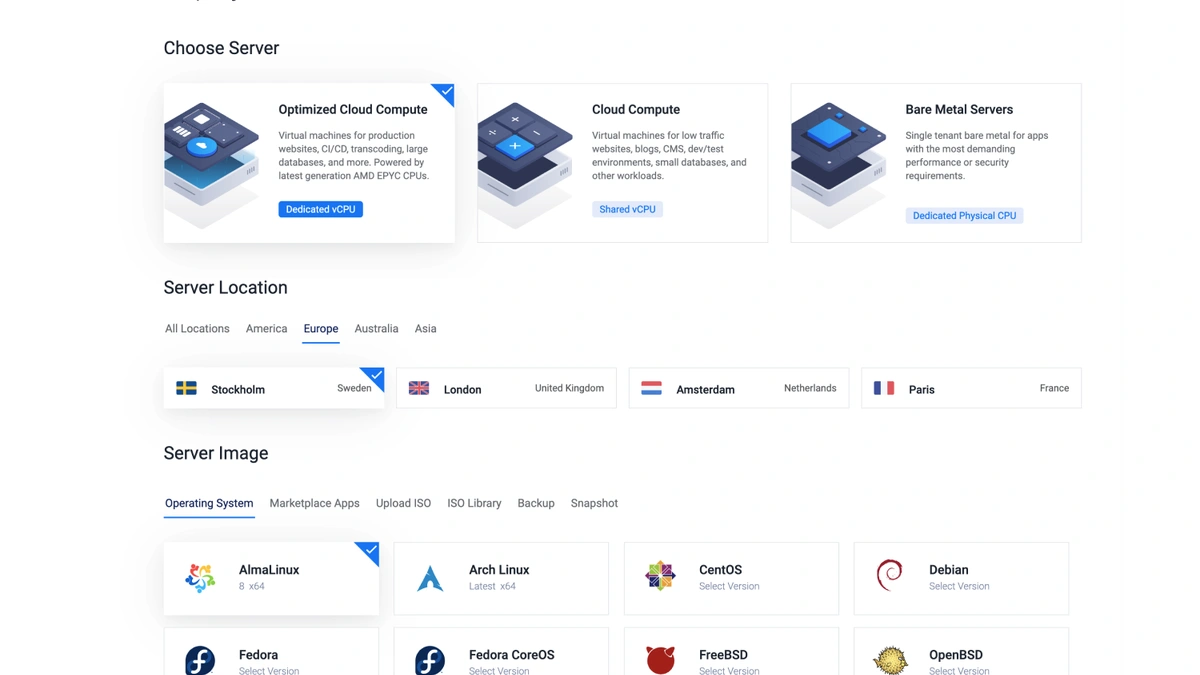
Vultr is the widest-footprint option in VPS hosting for developers, running Vultr Cloud Compute across 32 global data center regions covering North America, Europe, Asia-Pacific, Latin America, Africa, and Oceania. Vultr High Performance instances start at $6.00 per month for 1 vCPU, 1 GB RAM, 25 GB storage, and 2 TB of bandwidth, per the Vultr pricing page. A bare-minimum IPv6-only tier at $2.50 per month exists on the lower end but ships without IPv4, so it fits only sidecar workloads and never primary web traffic, per the same source. Vultr suits teams building latency-sensitive applications, edge compute deployments, or global multi-region backends. Vultr Bare Metal sits alongside Cloud Compute for workloads that need dedicated vCPU performance without KVM virtualization overhead, and Ampere Altra ARM instances are a first-class option for cost-tuned Docker container deployment on ARM64.
- 32 global data center regions are the widest edge footprint of the four vendors here, useful for latency-sensitive workloads and multi-region rollouts.
- NVMe SSD storage on the High Performance tier plus 10 Gbps network cards on top-end instances suit I/O-bound Docker container deployment and busy database workloads.
- Vultr Bare Metal, Ampere Altra ARM instances, VKE managed Kubernetes, Vultr Object Storage, and Vultr Block Storage extend the same Vultr API and Terraform provider support onto dedicated and ARM hardware without changing tooling.
The honest limitations: Vultr's first-party documentation is thinner than DigitalOcean's, and the Vultr Marketplace ships fewer one-click stacks; expect to lean on community tutorials for a first Kubernetes cluster or managed Kubernetes service setup. Some newer regions also see occasional capacity constraints on High Performance NVMe SSD storage tiers during heavy product launches. Visit Vultr to compare Cloud Compute and High Performance plans.
Linode by Akamai: Best for Predictable Pricing and Stable Infrastructure
Linode by Akamai is the boring-in-a-good-way pick for VPS hosting for developers: flat monthly rates, no surprise bandwidth overage charges (traffic beyond your allocation is throttled, not billed), and Akamai CDN integration since the 2022 acquisition. Shared CPU plans start at $5 per month, or $0.0075 per hour, for 1 vCPU, 1 GB RAM, and 25 GB storage, per the Akamai Cloud Compute plan documentation. Shared CPU scales up to 192 GB RAM and 32 vCPUs within the same plan class, per the same source. Linode fits solo developers and small teams that value pricing they can forecast for the next 12 months. The Linode Cloud Manager, Linode API, and the official Linode Terraform provider give a clean API-driven provisioning experience; LKE covers managed Kubernetes; NodeBalancer plus Akamai CDN closes the ingress path; and Linode Object Storage and Linode Block Storage cover the storage primitives.
- Flat, forecastable pricing. No unexpected bandwidth overage charges: exceeding your allocation throttles the instance instead of adding to the invoice.
- Akamai CDN and NodeBalancer integration deliver edge caching and managed load balancing without stitching in third-party services.
- Linode Dedicated CPU plans give predictable dedicated vCPU performance for workloads that outgrow burstable Shared CPU tiers, all through the same Linode API and Terraform provider surface.
The honest limitation: the 2022 Akamai acquisition is still producing branding and interface inconsistencies. Some pages reference Linode Nanode, others Akamai Cloud Compute; www.linode.com/pricing/ redirects to akamai.com; and the Cloud Manager migration remains partial. New docs sit at techdocs.akamai.com while older tutorials remain on linode.com. Teams new to the platform should expect to spend a few minutes reconciling brand names. Visit Linode to review Shared CPU and Dedicated CPU plan types.
Hetzner: Best for Maximum Raw Compute per Dollar

Hetzner Cloud is the price-per-vCPU champion in VPS hosting for developers by a significant margin. The Hetzner CX23 tier, successor to the CX22, is listed at EUR 5.49 per month or USD 6.49 per month effective 15 June 2026, per the official Hetzner price adjustment notice. That is competitive with any comparable Shared CPU tier at the other three vendors, and Hetzner CPX21 and higher tiers extend the price advantage as you scale to more RAM and dedicated vCPU performance. Hetzner suits cost-sensitive solo developers, side projects, and teams whose customers sit in Europe or the eastern half of North America. Hetzner Bare Metal (via the Hetzner Robot dashboard) sits alongside Hetzner Cloud for teams that want dedicated hardware, and Hetzner Load Balancer, Hetzner Private Networks, Hetzner Floating IP, and Hetzner Object Storage round out the primitives expected from a mainstream cloud.
- Lowest price-per-vCPU of the four vendors here, by a wide margin. CX23 and CPX21 are especially cost-effective for staging environments and CI/CD build pipeline runners.
- Official Hetzner API, hcloud CLI, and Terraform provider support deliver an API-driven provisioning surface identical in ergonomics to DigitalOcean and Linode.
- Private VPC networking is included and free across all Hetzner Cloud instances, useful for keeping database traffic off the public internet.
The honest limitations: Hetzner data centers are concentrated in Europe (Nuremberg, Falkenstein, Helsinki) and two US locations (Hillsboro, Oregon and Ashburn, Virginia), with no Asia-Pacific or Latin American footprint. Teams whose users sit in Tokyo, Singapore, or Sydney should choose Vultr for edge proximity instead. Support is also lighter-touch than the other three vendors; expect to self-serve through documentation and community forums. Visit Hetzner to review current Cloud tiers and Bare Metal options.
How to Choose the Right VPS for Your Dev Stack
Choosing VPS hosting for developers comes down to matching one of four axes to your dominant constraint: cost, ecosystem, pricing stability, or global reach. The developer VPS market is a genuine commodity at the entry tier, so pick on the constraint that hurts most, and switch tools only when the initial pick genuinely blocks you.
- Solo developer or side project, cost is the priority. Hetzner for the lowest price-per-vCPU; Linode for the most predictable monthly bill without bandwidth overage charges.
- Team with API-first or GitOps workflow. DigitalOcean for the deepest first-party documentation, the most complete Terraform provider support, and clean DOKS-plus-Marketplace integration. Compare the tooling in Terraform, Ansible, and CloudFormation compared for infrastructure automation.
- Global, latency-sensitive application or edge deployment. Vultr for 32 regions and NVMe SSD storage, plus Ampere Altra ARM instances when the workload is cost-tuned for ARM64.
- When to skip the unmanaged virtual server entirely. Teams that lack Linux administration bandwidth should consider Fly.io, Render, Railway, Vercel, Netlify, or Heroku as PaaS alternatives with zero-ops deployments. For AWS-native stacks, deploying applications on AWS across EC2, Lambda, and ECS covers the compute-service choice on that stack.
All four vendors on this list use KVM virtualization, ship Ubuntu, Debian, Rocky Linux, AlmaLinux, and Fedora images, run Docker container deployment cleanly, offer a managed Kubernetes service, and expose an official Terraform provider. The choices that separate them are pricing model, region breadth, and ecosystem depth. Solo developers typically anchor to Hetzner for cost or DigitalOcean for docs; teams with existing PostgreSQL, Redis, NGINX, and Certbot workloads and a working CI/CD build pipeline can move to any of the four without significant rework.
Further reading
Frequently Asked Questions
Do I need a managed or unmanaged VPS for a developer project?
Unmanaged VPS is the right fit for most developer projects: you get root SSH access, full OS control, and the freedom to run any runtime, container engine, or database. Managed VPS adds a web control panel and automated updates but restricts software choices and costs significantly more. If you are comfortable with SSH and basic Linux administration, start unmanaged and scale to a managed layer only if your team lacks sysadmin capacity.
Can I run Docker and Kubernetes on all four of these VPS providers?
Yes. All four providers use KVM virtualization and give you full root access, so installing Docker, running Docker Compose, or bootstrapping a Kubernetes cluster with k3s or kubeadm works on any of them. Each provider also offers a managed Kubernetes service (DOKS for DigitalOcean, VKE for Vultr, LKE for Linode, and managed K8s on Hetzner Cloud) if you would rather not maintain the control plane yourself.
What VPS plan size should a developer start with?
A 2 GB RAM, 1 to 2 vCPU plan is the standard starting point for a solo developer running a web application, staging environment, or Node.js or Python API server. Plans with 1 GB of RAM work for static site hosts and lightweight tasks but hit memory limits under modern build tools and package managers. Upgrade when sustained RAM utilization exceeds 70 percent or you see high CPU wait times during builds.
Can I use Terraform to provision servers across all four providers?
Yes. The Terraform Registry includes official providers for DigitalOcean, Vultr, Linode, and Hetzner, letting you manage infrastructure across all four platforms from a single state file. You can define droplets, instances, block volumes, DNS records, and firewalls in HCL for each. Pulumi and Ansible also support all four providers for teams that prefer Python or YAML-based workflows.