IPv6 is a network protocol that replaces the 32-bit addressing scheme of IPv4 with a 128-bit address space, supporting approximately 340 undecillion unique addresses and eliminating the NAT workarounds that constrain modern cloud and hosting infrastructure.
The shift matters because address scarcity is no longer theoretical. Regional Internet registries exhausted their IPv4 free pools between 2011 and 2019. Hosting providers now trade IPv4 addresses on secondary markets at prices that exceed $50 per address. For operators building new infrastructure, Internet Protocol version 6 is the baseline, and IPv4 is the legacy layer they must accommodate during transition.
What IPv4 Is and Why It Is Running Out
IPv6 addresses a structural limit baked into its predecessor since 1981. RFC 791 defined IPv4 using a 32-bit address field, yielding exactly 4,294,967,296 unique addresses. CIDR notation (Classless Inter-Domain Routing) stretched that pool by replacing fixed class boundaries with variable-length subnet masks, written as a prefix length after a slash, for example 192.168.1.0/24. Even with CIDR notation improving allocation efficiency, IPv4 address exhaustion became inevitable as internet-connected devices multiplied beyond what the protocol designers anticipated. IANA (the Internet Assigned Numbers Authority) exhausted its global IPv4 free pool in February 2011. APNIC followed that same year; RIPE NCC reached exhaustion in 2019.
The NAT Workaround and Its Costs
Network Address Translation (NAT) became the primary mechanism for extending IPv4 life after free-pool depletion. A NAT-enabled router maps many private IP addresses, drawn from reserved ranges like 10.0.0.0/8 or 192.168.0.0/16, to a single public IPv4 address. The router maintains a state table tracking which internal host originated each outbound session and rewrites packet headers on the return path.
The overhead is real. NAT state tables consume router memory proportional to active session count. End-to-end connectivity breaks for protocols that embed IP addresses in their payload, including SIP for VoIP and some peer-to-peer applications. IPsec tunnel establishment becomes complicated because NAT rewrites the source address that IPsec authentication headers protect. Per-packet header translation adds latency that compounds at scale. Hosting providers that provision shared IPv4 blocks and run NAT between tenants pass that friction upstream: slower origin response times and constrained outbound connection pools affect tenants building on cloud infrastructure at scale. NAT works adequately for standard HTTP workloads, but IPv4 address exhaustion combined with carrier-grade NAT stacking creates conditions where the workaround generates more operational cost than a direct IPv6 migration.
- IPv4
- 32-bit addressing protocol defined by RFC 791 in 1981. Supports 4.3 billion unique addresses. Uses dotted-decimal notation (e.g., 192.168.1.1). Dependent on CIDR notation and NAT for address conservation.
- IPv6
- 128-bit addressing protocol defined by RFC 8200. Supports approximately 340 undecillion unique addresses. Uses colon-separated hexadecimal notation (e.g., 2001:0db8:85a3::8a2e:0370:7334). Eliminates NAT requirement through direct end-to-end addressing.
- CIDR notation
- Classless Inter-Domain Routing prefix notation that expresses subnet size as a slash followed by the number of network bits (e.g., /24 for a 256-address block). Used in both IPv4 and IPv6 subnetting and routing.
- Network Address Translation (NAT)
- Router function that maps multiple private IP addresses to one or more public addresses using a session state table. Extends IPv4 address capacity but breaks end-to-end connectivity and complicates IPsec integration.
How IPv6 Works: Address Structure and Key Concepts
IPv6 represents every address as eight groups of four hexadecimal digits separated by colons, for example 2001:0db8:85a3:0000:0000:8a2e:0370:7334. Consecutive all-zero groups compress to a double colon (::), so that address shortens to 2001:0db8:85a3::8a2e:0370:7334. The 128-bit address space divides into a network prefix and an interface identifier, expressed in CIDR prefix the same way IPv4 subnets are written: a /64 prefix leaves 64 bits for interface addressing within that subnet.
IPv6 defines three address categories operators encounter daily. Unicast addresses route to a single interface. Multicast addressing routes to a group of interfaces simultaneously; it replaces IPv4 broadcast, which IPv6 eliminates entirely. Anycast routes to whichever interface in a group is topologically nearest, making it the mechanism behind CDN edge node selection and DNS resolver distribution.
Stateless address autoconfiguration (SLAAC), standardized in RFC 4862, allows a host to generate its own IPv6 address without a DHCP server. The host combines the network prefix advertised by its router with an interface identifier derived from its MAC address using the EUI-64 algorithm. SLAAC makes large deployments easier to manage because hosts self-configure when they detect a router advertisement on the link.
The neighbor discovery protocol (NDP), defined in RFC 4291 and the IPv6 addressing architecture, replaces IPv4's ARP (Address Resolution Protocol). NDP handles address resolution between MAC addresses and IPv6 addresses, router discovery, prefix advertisement, and duplicate address detection. Each IPv6 interface automatically gets a link-local address in the fe80::/10 prefix range. Link-local addresses are non-routable and exist only for on-link communication between directly connected nodes; they appear on every IPv6-capable interface regardless of whether global addressing is configured.
- Unicast
- One-to-one delivery. Packets go to a single identified interface. Global unicast addresses (2000::/3) are routable across the internet.
- Multicast
- One-to-many delivery. Multicast addressing routes packets to all members of a defined group. Replaces broadcast in IPv6. Prefix: ff00::/8.
- Anycast
- One-to-nearest delivery. Assigned to multiple interfaces; routing delivers packets to the topologically closest one. Used in DNS and CDN infrastructure.
- Link-local address
- Auto-configured non-routable address in the fe80::/10 range. Present on every IPv6 interface. Used for neighbor discovery protocol operations and on-link communication.
- SLAAC (stateless address autoconfiguration)
- Host self-configuration mechanism defined in RFC 4862. Host combines router-advertised prefix with EUI-64 interface identifier. No DHCP server required.
IPv6 Header Format vs IPv4 Header
The IPv6 header format is fixed at 40 bytes. The IPv4 header varies from 20 to 60 bytes because of its Options field. The IPv6 header format removes the checksum field, offloading integrity verification to the transport layer (TCP, UDP). It eliminates fragmentation fields from the base header; in IPv6, only the originating host fragments packets, not intermediate routers. The TTL field becomes Hop Limit, serving the same function under a clearer name. Optional processing moves to extension headers that follow the base header in a chain: Routing, Fragment, Authentication Header, and Encapsulating Security Payload are the common extension types. Intermediate routers skip extension headers they do not need to process, which streamlines forwarding compared to IPv4 option parsing. The authoritative specification is RFC 8200.
| IPv4 Field | IPv6 Equivalent |
|---|---|
| Version (4 bits) | Version (4 bits, value 6) |
| IHL , variable header length | Fixed 40-byte header; no length field needed |
| Header Checksum | Removed; offloaded to transport layer |
| Fragmentation fields (ID, Flags, Offset) | Fragment extension header (end-to-end only) |
| TTL | Hop Limit |
| Protocol | Next Header (points to extension header chain) |
| Options (variable) | Extension headers (chained, skippable) |
| Source / Destination (32-bit each) | Source / Destination (128-bit each) |
IPv4 vs IPv6: A Side-by-Side Comparison
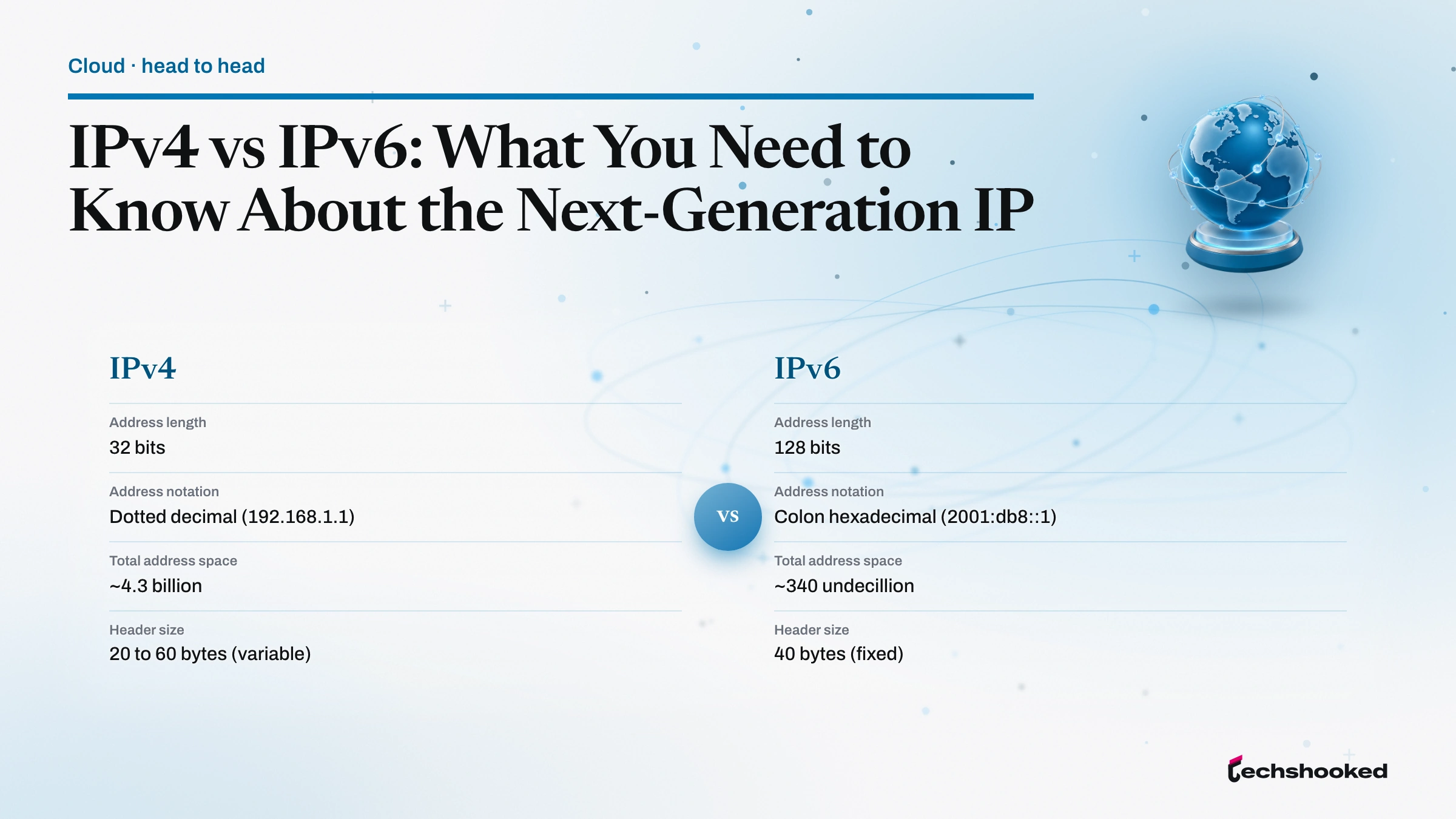
IPv6 and IPv4 differ across every operational dimension that matters to hosting and cloud operators: address capacity, subnetting and routing efficiency, security posture, and configuration overhead. The table below captures the most operationally significant differences.
| Attribute | IPv4 | IPv6 |
|---|---|---|
| Address length | 32 bits | 128 bits |
| Address notation | Dotted decimal (192.168.1.1) | Colon hexadecimal (2001:db8::1) |
| Total address space | ~4.3 billion | ~340 undecillion |
| Header size | 20 to 60 bytes (variable) | 40 bytes (fixed) |
| Fragmentation | Routers and hosts | Source host only |
| Broadcast support | Yes | No , multicast addressing replaces broadcast |
| IPsec integration | Optional (RFC 4301) | Mandatory support (RFC 6434) |
| Configuration method | DHCP or manual | SLAAC, DHCPv6, or manual |
| NAT requirement | Required at scale | Not required |
| Subnetting and routing | CIDR format; fragmented BGP table | Prefix notation; provider-aggregatable prefixes reduce BGP table size |
The IPsec integration row carries the most weight for operators concerned with network security. IPv4 treats IPsec as optional per RFC 4301; individual deployments must explicitly configure Authentication Header or Encapsulating Security Payload. IPv6 mandates IPsec support per RFC 6434, meaning every IPv6-capable device must implement the full IPsec stack even when a specific deployment does not require active encryption. This baseline does not eliminate the need for application-layer TLS, but it means the network layer has authentication and encryption primitives available by default rather than by configuration choice. For cloud workloads handling regulated data, that distinction matters to compliance teams.
DNS resolution also changes. IPv4 addresses map to A records. IPv6 addresses require AAAA DNS records, and operators enabling dual-stack must publish both record types to serve clients on either protocol version.
IPv4-to-IPv6 Transition Mechanisms for Hosting and Cloud
IPv6 adoption for existing infrastructure does not happen in a single cutover. Operators deploy transition mechanisms to run IPv6 and IPv4 in parallel or to bridge between protocol versions during migration. RFC 4213 provides the foundational overview of basic transition mechanisms for IPv6 hosts and routers. Three categories cover the practical options.
- Dual-stack deployment. The host or network device runs both IPv4 and IPv6 simultaneously. Applications connect over whichever protocol the destination supports. Dual-stack deployment is the preferred transition mechanism for new infrastructure because it avoids translation overhead and supports both protocol versions natively without tunneling. It requires the operating system, network interfaces, routing configuration, and security groups to be explicitly configured for both stacks.
- Tunneling. IPv6 packets are encapsulated inside IPv4 datagrams to traverse IPv4-only network segments. 6to4 tunneling (RFC 3056) uses the 2002::/16 prefix and automatically derives a tunnel endpoint from the IPv4 address, making it quick to deploy but prone to performance and reliability issues on asymmetric paths. For production environments, 6in4 manual tunnels with explicitly configured endpoints are more predictable than 6to4 tunneling. Teredo (RFC 4380) handles NAT traversal for IPv6 on Windows clients but is not appropriate for server deployments. This entire tunneling category is a transition mechanism for environments where infrastructure upgrades lag behind protocol adoption.
- Translation. NAT64 (RFC 6146) combined with DNS64 (RFC 6147) allows IPv6-only hosts to reach IPv4-only servers. The DNS64 resolver synthesizes AAAA records that map to the NAT64 gateway, which performs protocol translation on the packet. Mobile carriers use this approach widely; Apple requires NAT64/DNS64 compatibility for iOS 9 and later App Store submissions. Translation is a transition mechanism of last resort for cloud workloads because it reintroduces state and per-packet overhead that dual-stack avoids.
Dual-Stack on AWS, GCP, and Azure
Major cloud providers support dual-stack deployment at the VPC (Virtual Private Cloud) level. AWS added dual-stack VPC subnets for EC2, Elastic Load Balancing, and RDS in 2021. GCP dual-stack subnets reached general availability with support for both /29 IPv6 prefixes and standard IPv4 CIDR blocks. Azure dual-stack virtual networks and load balancers are generally available across regions. Hostinger, Hetzner, DigitalOcean, and Vultr assign IPv6 /48 or /64 prefixes to VMs by default on most plans. Enabling dual-stack at the VPC level does not automatically configure application load balancers or instance security groups; those require explicit IPv6 rules separate from existing IPv4 rules. Subnetting and routing tables must also reference IPv6 prefixes independently of IPv4 routes.
How IPv6 Affects Web Hosting Performance and Security
IPv6 removes NAT state overhead from the data path. Each IPv6 host has a routable global address, so packets travel end-to-end without translation. This matters for hosting specifically because shared IPv4 environments often stack multiple NAT layers: the hosting provider's internal NAT, the tenant's application firewall, and the ISP's carrier-grade NAT (CGNAT, defined in RFC 6888) on the client side. CGNAT is common among mobile carriers and budget ISPs. With IPv6 deployed on both origin and client, CGNAT drops out of the path entirely.
For virtual hosts, IPv6 means each site can receive a dedicated routable address from the provider's /48 or /64 prefix without consuming scarce IPv4 inventory. Shared hosting providers with exhausted IPv4 pools can extend IPv6 addressing to every new tenant without purchasing additional addresses on the secondary market.
CDN performance benefits from IPv6 when both origin and CDN edge speak the protocol natively. Cloudflare, Fastly, and Akamai serve IPv6 clients by default. When the CDN edge cannot reach an IPv4-only origin over IPv6, it performs an internal translation that adds a hop and a small latency penalty. Enabling IPv6 on the CDN edge and on the origin eliminates that conversion step. For DNS-based routing with providers like Route 53 or Cloudflare, serving AAAA records alongside A records ensures IPv6-capable clients resolve directly without falling back to IPv4.
Security requires active configuration. The mandatory IPsec integration in IPv6 per RFC 6434 provides network-layer authentication primitives, but the neighbor discovery protocol introduces its own attack surface. NDP is vulnerable to router advertisement spoofing and neighbor cache poisoning, the IPv6 equivalents of IPv4 ARP spoofing. NIST SP 800-119 covers the full threat model. Operators should configure the following on managed switches and routers when deploying IPv6 in a hosting environment.
- RA Guard (RFC 6105): blocks unauthorized router advertisement messages on access ports, preventing rogue devices from advertising themselves as default gateways.
- SEND (Secure Neighbor Discovery, RFC 3971): adds cryptographic signatures to NDP messages, preventing neighbor spoofing. Requires PKI infrastructure to deploy.
- DHCPv6 Guard: restricts DHCPv6 server responses to authorized ports, analogous to DHCP snooping in IPv4 environments.
- ICMPv6 filtering: allow necessary ICMPv6 types (types 133-137 for NDP, type 2 for Packet Too Big) and block types not required for operation. Stateless address autoconfiguration depends on ICMPv6, so blanket blocking breaks SLAAC.
- Firewall rule separation: most platforms maintain independent rule sets for IPv4 and IPv6. Verify that security group rules covering IPv4 traffic have corresponding IPv6 equivalents; an open IPv4 rule does not automatically apply to IPv6 on AWS, GCP, or Azure.
Practical Steps for Enabling IPv6 on Your Hosting Setup
IPv6 enablement for an existing hosted site is a configuration exercise, not a protocol migration. The checklist below applies to VPS, dedicated server, and cloud VM deployments. Operators running shared hosting depend on provider support and should verify IPv6 availability in the control panel before proceeding. See also: headless CMS.
- Confirm prefix assignment. Check the provider's control panel for an IPv6 prefix. Verify on the instance with
ip -6 addr show. The output should show a global unicast address (2000::/3 range) and a link-local address (fe80::/10 range). If no global address appears, request a prefix from the provider or enable it in the VPC subnet settings. - Configure the web server. Apache requires a separate
Listen [::]:443directive alongside the existing IPv4 listener. Nginx requireslisten [::]:443in the server block. Both can share the same TLS certificate. Dual-stack deployment at the application layer means binding to both 0.0.0.0 (IPv4) and :: (IPv6 any-address). - Update DNS. Add AAAA records for each hostname alongside the existing A records. The CIDR-style prefix of your IPv6 prefix determines which address you publish. Use the global unicast address, not the link-local IP, for public DNS.
- Audit firewall rules. Review cloud security groups and host-based firewall rules. IPv6 traffic requires independent allow rules on most platforms. A common oversight is enabling ports 80 and 443 for 0.0.0.0/0 (IPv4) but omitting the ::/0 (IPv6) equivalent. This migration mechanism gap causes IPv6 clients to time out even when the server is correctly configured.
- Test reachability. Use
curl --ipv6 https://yourdomain.comfrom an external host. The online tool test-ipv6.com provides a structured diagnostic. Google Search Console reports IPv6 crawl activity separately from IPv4 in its coverage reports, so expect a crawl split after publishing AAAA records. - Proxy during transition. Operators not ready to expose the origin directly over IPv6 can route traffic through a Cloudflare proxy, which handles IPv6 termination at the edge and forwards to the IPv4 origin. This provides IPv6 client support without requiring origin-side changes, and it eliminates 6to4 tunneling complexity for smaller deployments.
Operators who move through this checklist gain IPv6 coverage for a growing share of traffic. Google's IPv6 adoption statistics show over 45% of U.S. queries arriving over IPv6 as of recent reporting, driven by mobile carrier deployments and ISP upgrades. The 128-bit address space means subnet/routing for new services never require NAT workarounds, and the mandatory IPsec support baseline provides a stronger security posture at the network layer than IPv4 deployments that leave IPsec optional.
Further reading
- RFC 8200 , Internet Protocol, Version 6 (IPv6) Specification (IETF)
- RFC 4291 , IP Version 6 Addressing Architecture (IETF)
- RFC 4862 , IPv6 Stateless Address Autoconfiguration (IETF)
- RFC 6434 , IPv6 Node Requirements, mandates IPsec support (IETF)
- RFC 4213 , Basic Transition paths for IPv6 Hosts and Routers (IETF)
- NIST SP 800-119 , Guidelines for the Secure Deployment of IPv6
- Ecommerce Platforms Compared: Shopify, WooCommerce, BigCommerce, and Adobe Commerce
- Shopify vs WooCommerce vs BigCommerce: Which E-Commerce Platform Fits Your Store?
- Top E-commerce CMS Platforms for Online Stores: WordPress, Shopify, BigCommerce, Adobe Commerce