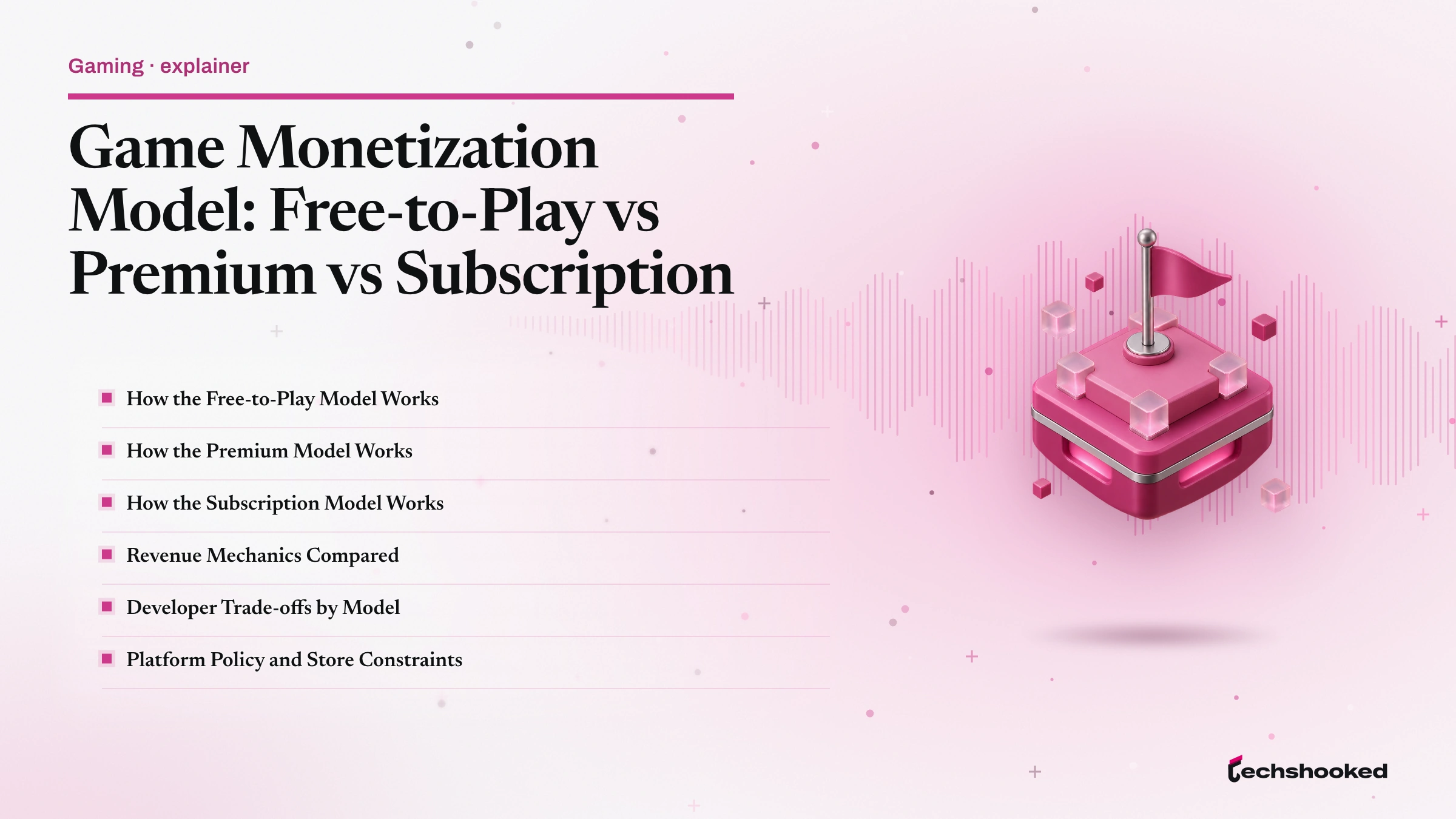
Game monetization model is a revenue framework that determines how a developer charges players for access, content, and ongoing engagement. The three dominant structures in the industry today are free-to-play (F2P), the premium one-time purchase model, and the subscription model, each with distinct mechanics for when money changes hands, who pays it, and what they receive in return. Genre conventions, platform policy, and studio production capacity all shape which model is viable for a given project. No single structure outperforms the others across every context, which is why the comparison between them remains a live question for developers at every scale.
How the Free-to-Play Model Works
The free-to-play model distributes the game at no upfront cost and generates revenue through optional in-game purchases, microtransactions, and advertising. Players download and access the core experience without spending anything, and monetization depends on converting a segment of that free audience into paying users over time. F2P mechanics vary by game type, but three revenue streams appear across almost all implementations.
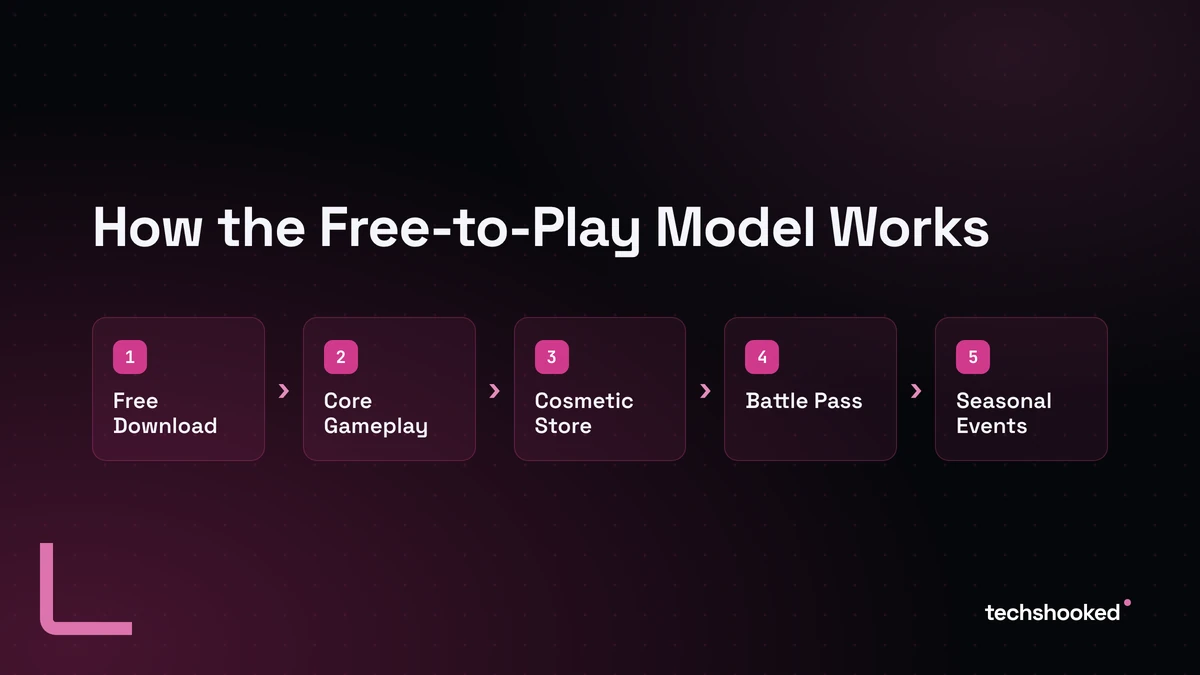
- Cosmetic microtransactions (MTX)
- Microtransaction (MTX) items such as character skins, weapon finishes, and emotes are sold for real money without affecting gameplay balance. The separation of paid cosmetics from gameplay power is the defining constraint that keeps F2P titles viable in competitive communities and regulatorily distinct from gambling mechanics in most jurisdictions.
- Battle pass
- A battle pass sells access to a time-limited reward track that players unlock by accumulating in-game experience. Players pay a flat fee per season, then earn cosmetic and currency rewards by playing. The battle pass structure converts player time into perceived value and sets a predictable per-cycle revenue event without requiring individual item purchases.
- Advertising and rewarded video
- Mobile F2P titles commonly integrate rewarded video placements, where players watch a short advertisement in exchange for in-game currency or extra lives. Direct display advertising also appears in casual games. This stream allows revenue generation from non-spending users, though it typically yields lower per-user value than direct in-game purchase conversion.
F2P live service games depend on retaining a large player base because total revenue is a product of player count and average spending per player. A detailed comparison of the economics of on-chain asset ownership versus traditional F2P spending is covered at blockchain gaming vs traditional gaming, which traces how blockchain mechanics interact with conventional F2P revenue design.
How the Premium Model Works
The premium model charges players a fixed one-time purchase price before they can access the game, with optional downloadable content (DLC) sold separately after launch. Revenue is front-loaded: the developer collects from each sale at launch, and total earnings are determined primarily by unit volume rather than per-player spending depth over time. Four structural properties define how the premium revenue model operates.
- Upfront price as the primary revenue event. The purchase transaction happens before play begins. Price tiers for premium titles on PC and console platforms vary by genre and publisher scale, from lower-priced indie releases to full retail prices for major productions, with platform store listings set by the developer within platform-imposed ranges.
- No mandatory ongoing spend. Players who purchase the base game are not required to spend further to access the complete experience. The absence of spend pressure after purchase is a significant factor in how the premium model is perceived relative to F2P by price-sensitive audiences.
- DLC as an optional extension. Downloadable content extends the game's revenue tail after launch without gating the core experience. Story expansions, cosmetic packs, and additional game modes sold as DLC give players discrete spending choices rather than an ongoing MTX feed.
- Finite production scope. The premium model does not require continuous live content updates to sustain revenue. A title can generate revenue from its launch window without the backend infrastructure and content cadence a live service game demands, which reduces ongoing operational costs for studios with smaller teams.
How the Subscription Model Works
The subscription model charges players a recurring fee, typically monthly or annually, for access to a catalog of titles or a continuous stream of new content. Rather than purchasing individual games, subscribers pay for access to a library, with the platform or publisher curating which titles are included. Four properties characterize subscription monetization in practice.
- Recurring billing cycle. Revenue accrues on a predictable schedule tied to subscriber count. The monthly or annual renewal structure gives publishers a forecasting baseline that neither F2P nor the premium model can match directly, because F2P revenue is conversion-dependent and premium revenue is launch-concentrated.
- Library access model. Subscribers access titles for the duration of their subscription without per-title payment. Xbox Game Pass and Apple Arcade are two named implementations of this structure: Game Pass offers a rotating library of first-party and third-party titles across console and PC; Apple Arcade provides a curated mobile and Apple TV catalog with no in-game purchases within titles.
- Churn rate as the primary business risk. A subscription service fails when more subscribers cancel than new ones join. Player retention is therefore central to the subscription model's unit economics. Unlike F2P, where a player who stops spending still contributes session data and can return to spend later, a subscriber who churns removes their recurring revenue contribution immediately.
- Catalog breadth dependency. A subscription library must maintain enough appealing titles to justify recurring spend. Publishers assembling or licensing catalog content face ongoing acquisition costs, and subscriber expectations about new release availability on day one add further pressure on licensing negotiations. Cloud gaming platforms, which sometimes bundle subscription access with streaming delivery, are compared separately at cloud gaming platforms comparison.
Revenue Mechanics Compared
Game monetization models differ most sharply on revenue timing, the conversion funnel from free to paying user, and sensitivity to player churn. The table below places the three models against five operational dimensions that developers and publishers use to evaluate model fit. Distribution and platform context for these models, particularly for independent developers, is covered at compare indie game publishing platforms.
| Dimension | Free-to-Play | Premium | Subscription |
|---|---|---|---|
| Revenue timing | Ongoing; tied to in-game purchase events across the player lifetime | Front-loaded at purchase; DLC extends tail | Recurring per billing cycle; predictable but churn-sensitive |
| Conversion requirement | Non-payer base required to build audience; small share converts to paying users | Every player is a buyer before access is granted | Subscriber commits to recurring billing before or at library access |
| Primary churn driver | Player disengagement reduces the audience available for future MTX events | Refund window; no structural churn mechanism post-purchase | Churn rate is the decisive metric: subscription cancellation removes recurring revenue immediately |
| Average revenue per user (ARPU) structure | ARPU is skewed by high-spending users (often called "whales"); median non-payer ARPU is zero | ARPU equals the purchase price plus any DLC spend; more uniform distribution | ARPU equals the subscription fee per period; uniform by design |
| Developer infrastructure cost | Live service backend, content pipeline, and moderation at scale | Launch infrastructure; post-launch support is optional | Platform or publisher manages library delivery; individual title cost varies |
Average revenue per user (ARPU) calculations differ structurally across the three models. In F2P, ARPU figures are pulled upward by a small cohort of high-spending players, which means median spend is far below the arithmetic mean. Premium ARPU is bounded by the price tier and DLC catalog, with narrower distribution. Subscription ARPU is fixed by the fee structure and reflects the platform or publisher's pricing decision rather than per-player spending behavior.
Developer Trade-offs by Model
Each game monetization model imposes different operational demands on the development studio, from content cadence requirements to backend infrastructure investment. Player retention and monetization have become central business statistics in free-to-play development, per Measuring Player Retention and Monetization Using the Mean Cumulative Function (IEEE Transactions on Games, 2020), and revenue model choice shapes both what gets built and how the studio operates after launch. The decision sequence below reflects how most developers prioritize these trade-offs.
- Content production capacity. A live service F2P game requires a continuous stream of new seasonal content, battle pass tiers, and limited-time events to sustain player engagement and conversion opportunities. A premium model requires a defined scope shipped at launch, with DLC as a separate production effort. Studios without a dedicated live operations team are structurally better suited to the premium model or to releasing into a subscription catalog as a finished title.
- Player community tolerance for monetization visibility. Different player communities have different expectations about how money and gameplay interact. Competitive and session-based genres (battle royale, MOBA, card games) have normalized F2P with cosmetic MTX. Narrative single-player genres have established the premium model as the default, and audiences in those genres often respond negatively to in-game purchase prompts. Misjudging this tolerance is a common cause of community backlash: the CHI 2022 study Prevalence and Salience of Problematic Microtransactions in Top-Grossing Mobile and PC Games: A Content Analysis of User Reviews analyzed 801 negative player reviews and found players objecting to unfair, opaque monetization and to monetization-driven design itself.
- Platform fee structure impact on net revenue. Every distribution platform takes a revenue share from game sales, in-game purchases, and subscription licensing payments. The specific split varies by platform and by revenue tier. A game generating revenue through in-game purchases on mobile platforms operates under different fee structures than a premium title sold on PC storefronts. Net revenue per transaction is a function of gross price minus platform fee, and this arithmetic changes materially across model and platform combinations.
- Marketing budget for user acquisition versus word-of-mouth. F2P titles often require paid user acquisition campaigns because the barrier to download is zero and organic discovery alone may not fill the funnel. Premium titles rely more on launch window visibility and review coverage. Tools for validating game quality before marketing investment are covered at game testing tools comparison.
- Long-term player relationship model. The subscription model builds a relationship between the player and a platform rather than between the player and an individual title. F2P builds a long-term relationship with the game itself through progression systems, seasonal content, and community. The premium model typically ends the commercial relationship at purchase, with optional DLC reactivating it. Each structure implies a different post-launch support obligation and a different ongoing marketing requirement.
Platform Policy and Store Constraints
Game monetization choices interact directly with platform store policies that govern what purchase types are permitted, how billing is handled, and what revenue share the platform takes. The platform layer is not passive: store rules define the boundary conditions for each revenue model, and a monetization design that works on PC may require significant adjustment for mobile or console distribution. Hardware platform comparisons relevant to these distribution decisions appear at Steam Deck vs Nintendo Switch performance. Key constraints by model include the following.
- Apple App Store mandatory in-app purchase routing. iOS games that include in-game purchases must process transactions through Apple's in-app purchase system. External payment links within apps are restricted. This applies to all free-to-play titles and any premium game offering in-game purchase expansions. The Apple App Store Review Guidelines specify the permitted purchase types and billing handling requirements in detail.
- Google Play parallel requirements. Google Play enforces similar in-app billing requirements for Android game purchases and in-game purchases. Developers shipping F2P titles on Android must route transactions through the Play billing system for digital goods.
- Steam revenue split by earnings tier. According to Valve's Steam partner documentation, the standard revenue split is 70/30 in favor of the developer below the $10 million threshold, with improved splits at higher earnings tiers. This applies to both premium sales and in-game purchase revenue processed through Steam.
- Console platform review requirements for loot mechanics. Console platform holders apply their own content review standards to games featuring loot boxes or randomized in-game purchase mechanics. Several jurisdictions have also applied consumer protection standards to these mechanics, which interacts with how developers design F2P reward structures for console release.
- Subscription licensing terms vary by platform. When a title releases into a subscription service, the financial terms are negotiated separately from retail distribution. Licensing structures for subscription inclusion differ across services and are not governed by the standard platform store revenue split that applies to unit sales and in-game purchases.
Choosing a Monetization Model for Your Game
Game monetization model selection depends on genre conventions, target platform, studio scale, and the player community's established expectations for spending. The display characteristics of the hardware players use to access a title also shape viable models; a discussion of how platform hardware affects the broader gaming experience appears at gaming monitor buying guide. The decision checklist below structures the selection process for developers moving from concept to revenue design.
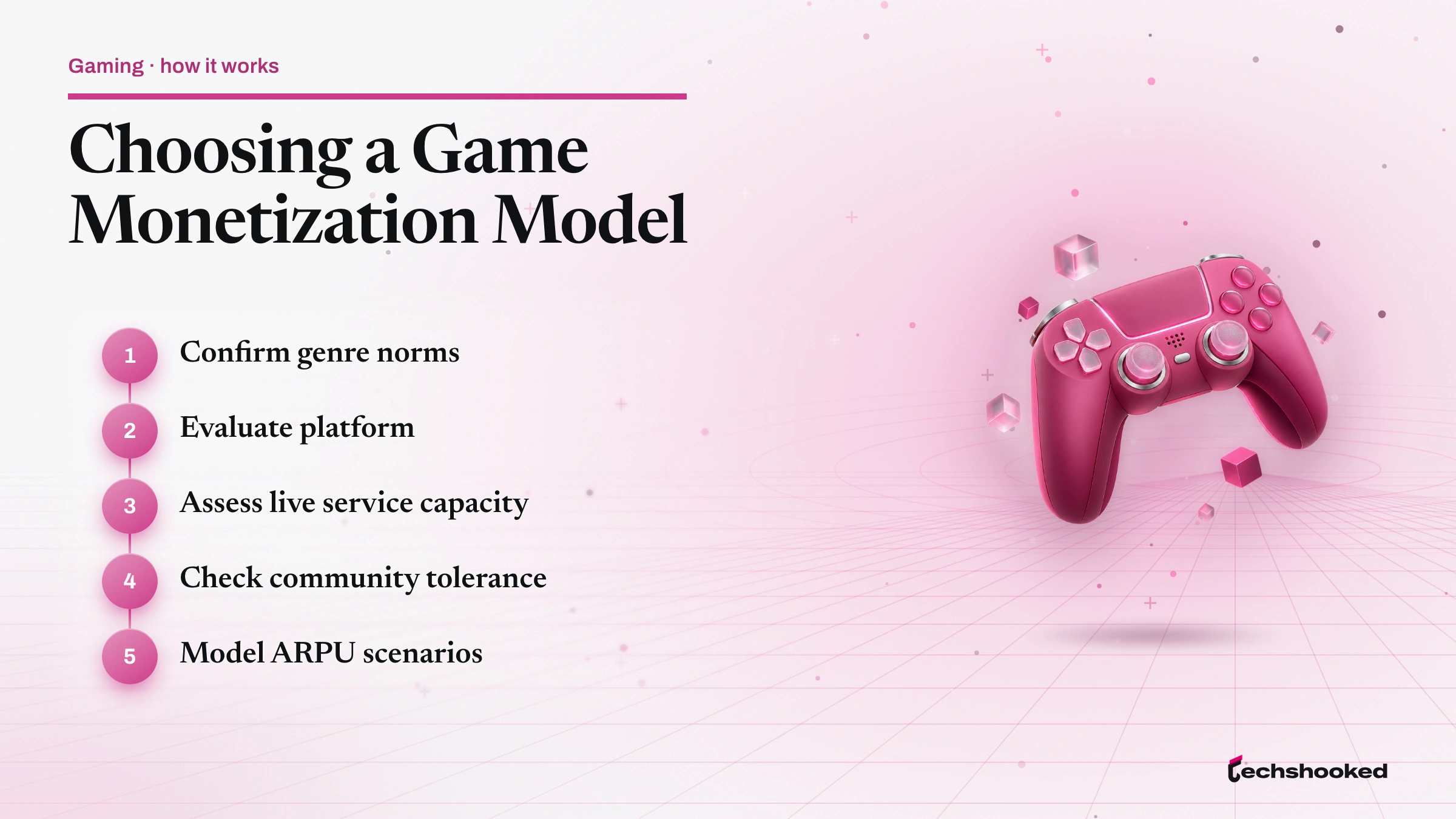
- Confirm genre norms. Competitive shooters, MOBAs, and collectible card games have normalized free-to-play with cosmetic MTX or battle pass revenue structures. Narrative RPGs, adventure games, and puzzle titles carry premium model precedent. Releasing a narrative single-player game as F2P with an in-game purchase feed creates friction with the genre's established player expectations, while releasing a competitive multiplayer game at a premium price restricts the accessible player base.
- Evaluate platform distribution. Mobile overwhelmingly favors F2P, because the platform's install and discovery mechanics reward free downloads and in-game purchase conversion. PC and console support premium pricing at established retail tiers, with F2P viable for multiplayer titles. Subscription model viability depends on whether the title can be licensed into an existing service or whether the developer is building a proprietary subscription offering, which requires a catalog rather than a single title.
- Assess studio capacity for a live service content pipeline. A live service F2P game requires sustained post-launch investment: seasonal updates, balance patches, new cosmetics, and community management. Studios without dedicated live operations capacity cannot maintain the content cadence that player retention in an F2P title requires. For those studios, the premium model or a subscription catalog release represents a lower ongoing operational obligation.
- Determine community tolerance for visible monetization. Player communities respond differently to monetization visibility. Some accept frequent in-game purchase prompts and seasonal battle pass offerings as normal; others treat any spending prompt as a breach of trust. Researching the genre's existing community discourse before finalizing the revenue model reduces the risk of a launch-window backlash that damages long-term player retention.
- Model projected ARPU across conversion scenarios. F2P ARPU projections require assumptions about the percentage of the player base that converts to paying users and the distribution of spending across that cohort. Premium ARPU is more predictable but depends on launch-window sales velocity. Subscription ARPU is fixed by the licensing or subscription fee. Running projected revenue scenarios across all three models against realistic conversion and retention assumptions gives developers a financial basis for the selection rather than a genre-convention assumption alone.
References
- Measuring Player Retention and Monetization Using the Mean Cumulative Function (IEEE Transactions on Games, 2020): measuring retention and lifetime value from incomplete free-to-play player data.
- Prevalence and Salience of Problematic Microtransactions in Top-Grossing Mobile and PC Games: A Content Analysis of User Reviews (CHI 2022): which microtransactions players find most problematic in top-grossing games.
- Reuters Technology: reported industry context on platform policy changes, developer financial trends, and live service game economics.
Further reading
Frequently Asked Questions
What are the benefits of subscription-based gaming for players?
Subscription gaming gives players access to a rotating library of titles for a fixed monthly fee, eliminating per-title purchase risk. Services such as Xbox Game Pass and Apple Arcade let subscribers try games they would not buy outright, which lowers the barrier to discovery. The main caveat is that access ends when the subscription lapses, so players do not own the games they play during the subscription period.
How do I choose the right monetization model for my game?
Start with your target platform and audience spending habits. Free-to-play works best on mobile and live-service PC titles where a large top-of-funnel audience can be converted to paying users over time. Premium pricing suits single-player games with defined scope and strong brand recognition. Subscription is most viable for large publishers with an existing catalog or for titles releasing into an established service as a third-party title.
Can a game change its monetization model after launch without alienating its existing player base?
Yes, but the transition requires careful handling of players who purchased under the original terms. Games that shift from premium to free-to-play typically grandfather in paying players with exclusive cosmetics or in-game currency as compensation. The safest mid-cycle change is adding a battle pass layer on top of an existing premium title, which is additive rather than restrictive.