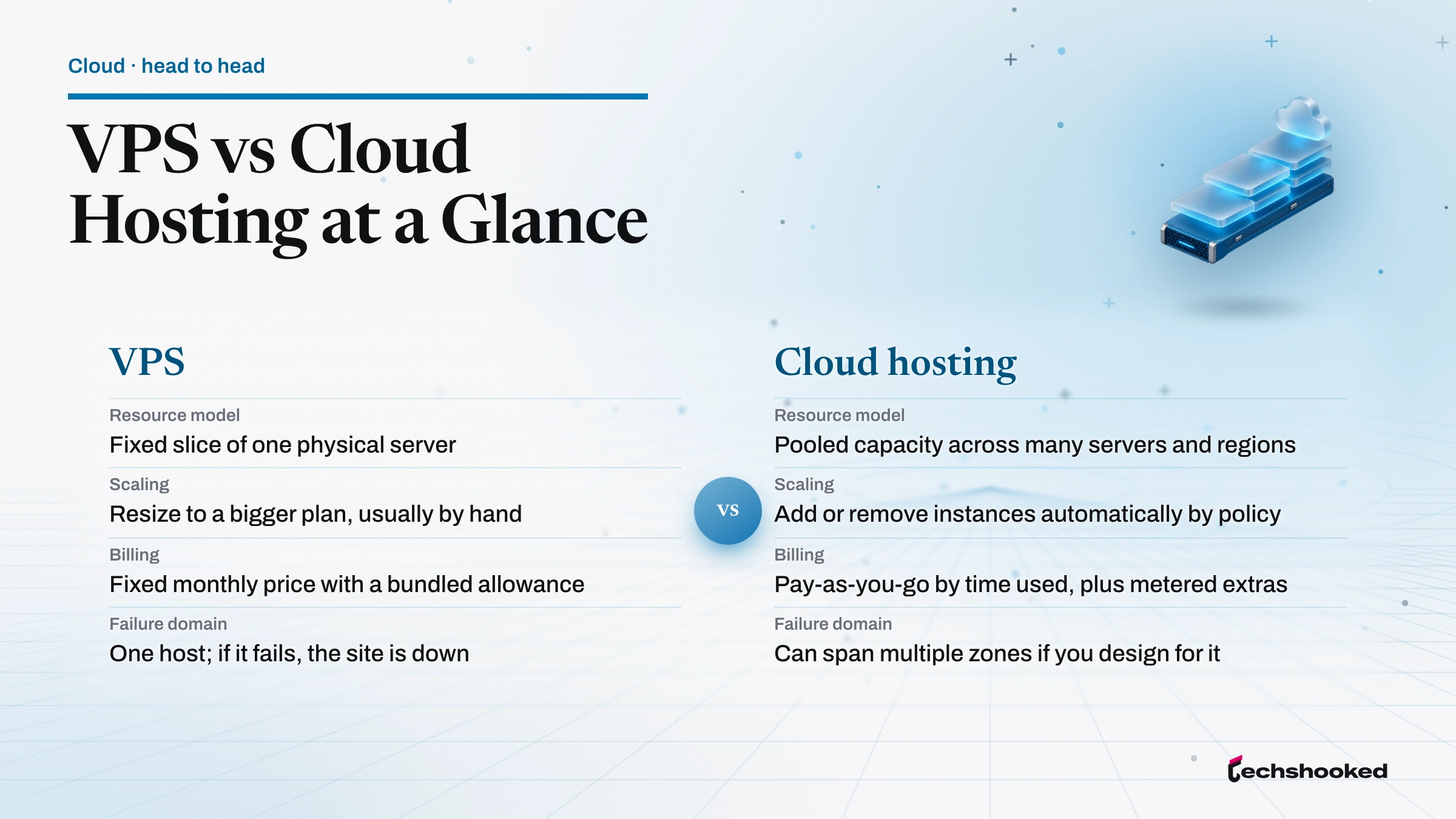
Shopify is a fully managed SaaS e-commerce platform that hosts your store, processes payments, and handles infrastructure so you never touch a server. WooCommerce takes the opposite route as a self-hosted WordPress plugin, and BigCommerce sits between them as a hosted platform whose payment fees depend on which processor you connect. That difference in hosting model, plus the way each vendor charges for payments, decides the real cost of running an online store.
How Each Platform Hosts Your Store
The most consequential difference between Shopify, WooCommerce, and BigCommerce is not pricing but hosting responsibility. Shopify and BigCommerce run on their vendors' servers as managed SaaS products, so the vendor carries updates, security patches, and capacity. WooCommerce uses a different hosting model. Per WooCommerce, it is an open-source platform powered by WordPress that lets merchants fully own their site, code, and data.
That control comes with duties. According to the developer releases page, only the most recent release is considered fully secure, so updating falls to whoever runs the store. The cloud architecture for scalable online stores explainer covers what that operational load looks like as traffic grows.
| Platform | Hosting | Updates and security | Scaling | Entry cost model |
|---|---|---|---|---|
| Shopify | Vendor-hosted SaaS | Handled by the vendor | Vendor infrastructure | Subscription plan |
| WooCommerce | Self-hosted on WordPress | Owner applies updates | Depends on your host | Free core, paid hosting and extensions |
| BigCommerce | Vendor-hosted SaaS | Handled by the vendor | Vendor infrastructure | Subscription plan |
Shopify: Plans From Basic to Plus
Shopify sells four plans: Basic, Grow, Advanced, and Plus. Per the Help Center, Grow is the plan that used to carry the plain Shopify name, so older comparisons that mention the mid-tier plan by its old name mean Grow. The pricing page lists what the first three cost in your region, so this article quotes no figure for them.
- Basic is the entry plan for a new online store.
- Grow is the renamed mid-tier plan.
- Advanced is the self-serve tier below Plus.
- Plus is the top tier. Per Shopify Plus pricing, it starts at $2,300 USD per month on a 3-year term or $2,500 per month on a 1-year term.
Payments are the second cost lever. The pricing page lists any fee for using a payment gateway other than Shopify Payments. The headless commerce with Next.js and Shopify guide covers teams that want a custom storefront on top.
WooCommerce: The Self-Hosted Flexibility Model
WooCommerce is a self-hosted WordPress plugin, so the core software is free but hosting, extensions, and maintenance are yours to pay for and manage. Each piece of that stack is a separate decision:
- WooCommerce core: the open-source plugin installs on a WordPress site, with costs coming from hosting, extensions, and payments.
- WordPress hosting: you choose and pay for the host, which sets speed, uptime, and scaling limits.
- Extensions: features beyond the core come from extensions, and many are paid.
- Maintenance: updates are the owner's job, and only the most recent release is considered fully secure per WooCommerce developer documentation.
- Payment gateway: WooCommerce adds no platform fee of its own, and the processor you connect sets the gateway fees.
Because everything runs on WordPress, the skills are the same ones a content site needs. The WordPress compared to Drupal for content-driven sites analysis explains how that foundation behaves in practice.
BigCommerce: Renamed Plans and the Open Payment Provider Fee
BigCommerce replaced Standard, Plus, and Pro with Core, Growth, and Scale, and renamed Enterprise to Performance. Per BigCommerce's plan update page, functionality is mostly unchanged, though Core drops included phone support. Plans are capped by gross merchandise value (GMV), BigCommerce's measure of gross order value after a 10% reduction. The table below follows BigCommerce's pricing page.
| Plan | Monthly | Billed annually | Revenue cap | Open Payment Provider fee |
|---|---|---|---|---|
| BigCommerce Core | $39 | $29 | Up to $30K trailing-twelve-month GMV | 2.0% |
| BigCommerce Growth | $105 | $79 | Up to $100K trailing-twelve-month GMV | 1.0% |
| BigCommerce Scale | $399 | $299 | $33,333 monthly GMV, then 0.9% above it | 0.6% |
| BigCommerce Performance | Custom | From $1,499 | Custom | None under contracted terms |
Two fee concepts appear in that table and should stay separate. The 0.9% on Scale applies to GMV above the monthly cap, while the 0.6% is the Open Payment Provider fee. Per BigCommerce, orders processed through Embedded Payment Providers such as Stripe, PayPal Braintree, and Adyen carry a $0 platform fee. Orders processed through any other Open Payment Provider carry a monthly fee on eligible order GMV, beginning June 1. Choosing Embedded Payment Providers is therefore the main way to avoid platform transaction fees on BigCommerce.
Pricing Comparison: Fees and Total Cost of Ownership
Subscription price is only one line in total cost of ownership (TCO), because hosting, apps, and payment fees move the bill more than the plan name does. The subscription plan is the most visible cost, yet transaction fees and other costs can matter as much. Each e-commerce platform prices those lines differently. Shopify's pricing page and BigCommerce's pricing page hold the plan figures, and WooCommerce has no plan price at all.
| Cost variable | Shopify | WooCommerce | BigCommerce |
|---|---|---|---|
| Base software | Monthly plan | Core plugin is free | Monthly plan |
| Hosting | Included | Bought from a WordPress host | Included |
| Payment fees | A fee may apply for gateways other than Shopify Payments | Set by the processor you choose | No platform fee through Embedded Payment Providers |
| Apps and extensions | Shopify-made apps usually free, third-party apps may charge | Paid extensions are common | Over 1,200 apps available |
Per Shopify, first-party apps are usually free, while third-party apps may charge. Processing costs deserve their own comparison: the Stripe, PayPal, and Square processing fees breakdown shows how rates differ, and the guide on how to choose a payment gateway for e-commerce covers the trade-offs. A store that moves volume to a cheaper processor can change its TCO faster than a plan upgrade would.
Feature Depth: Customization and Apps
Each platform trades out-of-the-box functionality against how far you can extend it with apps or code. Four terms frame the trade:
- Customization
- WooCommerce lets merchants fully own their site, code, and data, per WooCommerce, at the price of maintaining the code and host.
- Apps and extensions
- First-party Shopify apps differ from third-party apps in cost, per the Help Center.
- Headless builds
- A headless build separates the storefront from the commerce back end and adds developer work on any platform.
- Support
- BigCommerce Core no longer includes phone support, per the plan update page, so check the plan before assuming a phone line.
Which Platform Fits Your Store?
Your tolerance for running infrastructure, your payment provider mix, and your technical team size narrow the choice faster than any feature list.
- Shopify suits owners who want zero infrastructure work. Check the pricing page for any third-party gateway fee before committing.
- WooCommerce suits a WordPress team with developer capacity. Budget for hosting, extensions, and maintenance.
- BigCommerce suits owners who want hosting without the server work. Route orders through Embedded Payment Providers to avoid the platform fee, and watch the GMV cap on each plan.
For a narrower two-way choice, the Shopify vs WooCommerce SMB decision framework applies these criteria to small stores. Business buyers face different constraints, which the B2B vs B2C e-commerce hosting requirements analysis lays out. Stores leaving Magento can consult the Magento to Shopify migration considerations before switching.
Further reading
Frequently Asked Questions
What is the main difference between Shopify, WooCommerce, and BigCommerce?
Shopify and BigCommerce are hosted SaaS platforms, while WooCommerce is a self-hosted WordPress plugin. The store owner handles hosting, updates, and security on WooCommerce. The hosting model decides who carries maintenance work, which is why it matters more than any single feature.
What are BigCommerce's plan names?
BigCommerce's self-serve plans are Core, Growth, and Scale, with Performance for enterprise stores. They replaced Standard, Plus, Pro, and Enterprise, and BigCommerce says the underlying product functionality is mostly unchanged. Check the BigCommerce pricing page for prices and revenue caps.
Does BigCommerce charge fees on payments?
BigCommerce charges no platform fee on orders processed through its Embedded Payment Providers, such as Stripe, PayPal Braintree, and Adyen. Orders processed through any other Open Payment Provider carry a monthly fee based on eligible order volume, and the percentage differs by plan.
What did Shopify rename its mid-tier plan?
Shopify renamed the plan formerly called Shopify to Grow. Its plans are Basic, Grow, Advanced, and Plus, and Shopify's pricing page lists what each one costs in your region.
Is WooCommerce really free?
The WooCommerce core plugin is free, but running a store costs money. Hosting, paid extensions, and your chosen payment gateway are separate expenses, so total cost depends on how you build the store.