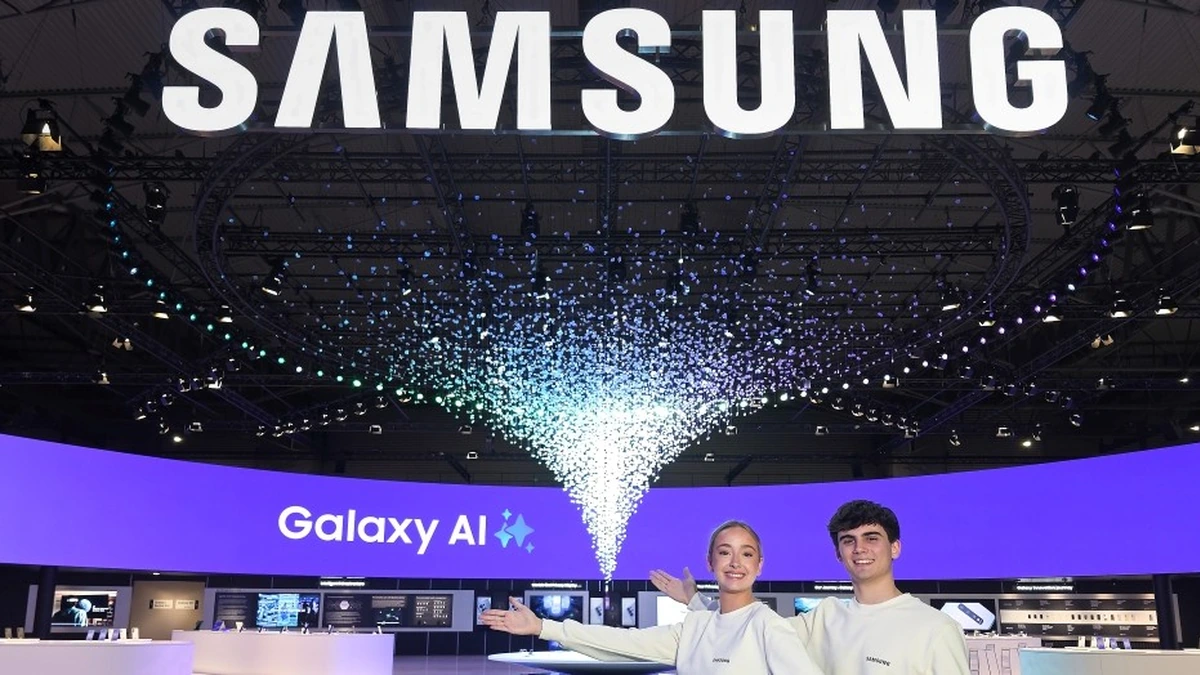
A week after launching the Galaxy S26, Samsung Galaxy AI turned up at Mobile World Congress carrying a larger argument: that it is no longer a phone feature but an assistant meant to follow the user across every device they own. At its booth in Hall 3 of Fira Gran Via in Barcelona, running March 2 to 5, the company put the S26 series at the center of what it calls an agentic companion spanning phones, wearables, tablets and emerging form factors, and paired the phones with the new Galaxy Buds4 to show the assistant handing off between hardware.
"MWC is an opportunity to show not only where Galaxy AI is today, but where it's going next," said TM Roh, head of Samsung's Device eXperience division, pointing to the Galaxy XR headset and the Galaxy TriFold as the next form factors in that plan. The show floor put both in hands-on stations alongside the Galaxy Book6 Pro and Book6 Ultra laptops, the Galaxy Tab S11, and Galaxy Watch8 health experiences covering running, sleep and mindfulness. The through-line is Samsung's claim that the assistant reads intent and acts on it, surfacing suggestions through Now Brief and Now Nudge and letting users pick between an upgraded Bixby, Gemini and Perplexity.
On connectivity, Samsung said it is expanding satellite communication for select Galaxy phones, including the S26 series, through carrier partnerships in North America, Europe and Japan for use when regular networks are down. It is an incremental widening rather than a new capability; Samsung has offered satellite messaging on select flagships and A-series phones since 2025, and the MWC news is about how many carriers and countries the service now covers.
The more revealing part of the exhibition sat away from the consumer devices. Samsung tied the same agentic framing to its own operations, demonstrating an AI-Driven Factories plan built on AI agents and digital-twin simulation that it aims to run across manufacturing by 2030, and a Connected Care health push strengthened by its 2025 acquisition of Xealth, which plugs digital health tools into physician workflows across hundreds of hospitals. Its networks unit went further, showing automation software it says is meant to make carrier networks fully autonomous by 2027.
Taken together, the message is that Samsung wants "agentic AI" to describe not just a phone but the factories that build it and the networks that carry it. That is a coherent story and a convenient one, since much of the on-device intelligence still runs on Google's and Perplexity's models rather than Samsung's own. What will decide whether the ecosystem pitch lands is mundane by comparison: whether the handoffs between an S26, a pair of Buds4 and a Watch8 actually feel continuous in daily use, or whether "connected" remains a booth demo. Samsung lays out the full exhibition in its MWC 2026 announcement.