
Quantum computing is a computational paradigm that exploits quantum mechanical phenomena such as superposition and entanglement to process information in ways that classical binary processors cannot replicate.
What Quantum Computing Actually Means
A qubit is a two-level quantum system whose qubit state is described by a probability amplitude, not a binary toggle. The standard visualization tool is the Bloch sphere: a unit sphere where the north pole represents the ground state (zero), the south pole represents the excited state (one), and any point on the surface represents a valid superposition of both. A classical bit can only sit at one of the two poles. A qubit can sit anywhere on the Bloch sphere surface, with each position encoding a distinct probability amplitude over the two basis states.
Quantum superposition is not a coin-flip where the outcome is simply unknown before measurement. The amplitudes are complex numbers that can constructively or destructively interfere with each other during computation. This interference is the mechanism that algorithms like Shor's and Grover's exploit to amplify correct answers and cancel incorrect ones. When a qubit is measured, the quantum superposition collapses to a definite zero or one according to the probability encoded in the amplitudes. After collapse, the quantum information is gone.
Different engineering approaches produce physical qubits with distinct tradeoffs in operating temperature, coherence time, and gate fidelity. For a detailed platform comparison, see IBM Quantum vs Google Quantum AI Comparison.
Qubit Hardware Modalities
| Modality | Key Vendors | Operating Temperature | Coherence Time (approx.) | Gate Fidelity Signal |
|---|---|---|---|---|
| Superconducting qubit | IBM, Google, Rigetti | ~15 millikelvin | 100-500 microseconds | 99.5%+ two-qubit gate fidelity on leading processors |
| Trapped-ion qubit | IonQ, Honeywell Quantinuum | Room temperature (vacuum trap) | Minutes to hours | 99.9%+ two-qubit gate fidelity reported |
| Photonic qubit | PsiQuantum, Xanadu | Room temperature (some cryogenic) | Propagation-limited | High single-qubit fidelity; two-qubit gates remain an engineering challenge |
The superconducting qubit platform dominates near-term research because fabrication techniques borrowed from semiconductor manufacturing allow rapid scale-up of qubit counts. Trapped-ion qubits offer longer coherence times and higher native gate fidelity but are harder to scale. Photonic approaches avoid the cryogenic overhead entirely and may prove advantageous for networked quantum systems.
Quantum Entanglement and Why It Matters for Computation
Quantum entanglement is a correlation between two or more qubits such that the measurement outcome of one instantly determines the outcome of the others, regardless of physical separation. No information is transmitted during measurement: the correlation was established when the qubits interacted, and measuring one simply reveals which pre-correlated outcome applies to the other.
In a quantum circuit, entanglement is created with two-qubit quantum gates. The most common is the CNOT gate (Controlled-NOT), which flips the target qubit conditional on the control qubit being in the one state. Applying a Hadamard gate followed by a CNOT quantum gate to two qubits in the ground state produces a Bell state, the simplest maximally entangled pair. Bell states are the building blocks of quantum teleportation, superdense coding, and error detection protocols.
Entanglement produces quantum speedup because a processor operating on n entangled qubits can manipulate 2n basis states simultaneously during computation. The ordered steps below capture how entanglement translates into computational power:
- Two qubits are prepared in superposition using Hadamard gates, placing each in an equal combination of zero and one.
- A CNOT gate entangles the two qubits, creating a Bell state where measurement outcomes are correlated.
- Subsequent gates apply transformations across the full entangled system, operating on all correlated amplitude combinations in parallel.
- A final measurement collapses the processor output to a classical bitstring, but the interference pattern built up during computation encodes the result of processing exponentially many configurations.
The "spooky action at a distance" framing from Einstein's objection to quantum mechanics accurately describes the measurement correlation, but has no bearing on information transfer. Quantum entanglement does not allow signals to propagate faster than light. It allows a quantum processor to encode and manipulate correlations across many qubits simultaneously, which is the mechanism that makes certain algorithms computationally superior to their classical counterparts.
Quantum Decoherence and Error Correction
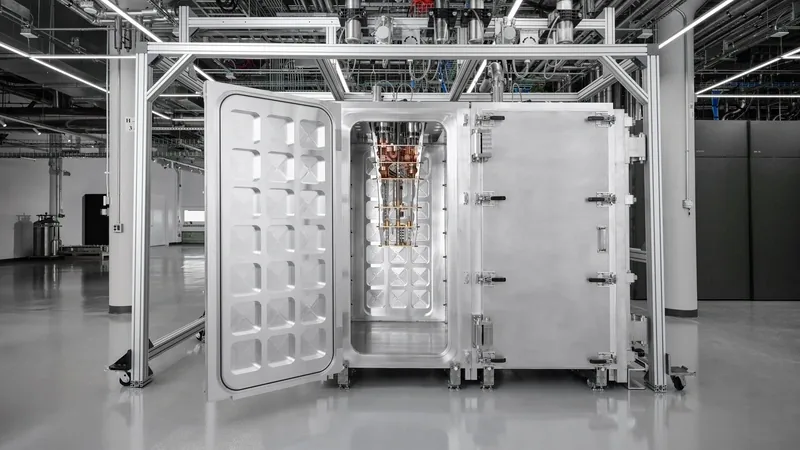
Quantum decoherence is the primary engineering obstacle in building practical quantum computers. A qubit maintains its quantum state only while isolated from environmental interactions. Any coupling to the surrounding thermal bath, electromagnetic noise, or mechanical vibration causes the qubit to lose its coherence and collapse to a classical mixture. Quantum noise accumulates on timescales measured in microseconds for superconducting qubits, which is why gate operations must complete before decoherence destroys the computation.
Quantum error correction addresses this by encoding one logical qubit across many physical qubits, so that errors on individual physical components can be detected and corrected without measuring and collapsing the encoded state. The key steps in a correction cycle are:
- Encode the protected state across a redundant array of physical qubits using an error-correcting code (the surface code is the leading candidate at scale).
- Measure ancilla qubits entangled with the data qubits, extracting error syndrome information without collapsing the encoded state.
- Apply classical decoding algorithms to interpret the syndrome and determine which physical errors occurred.
- Apply corrective operations to restore the encoded state before the next gate operation.
The cost is severe. Current estimates from IEEE Spectrum's analysis of the fault-tolerant quantum computing race put the physical-to-logical ratio at roughly 1,000 physical qubits per logical qubit at gate fidelity levels achievable with current hardware. IBM's processor roadmap, progressing through the Eagle, Osprey, Condor, and Heron generations, tracks improvements in gate fidelity and qubit connectivity that are necessary preconditions for reducing that ratio. The Heron processor architecture, documented in IBM Quantum's engineering publications, focuses on reducing quantum noise through improved qubit isolation and readout fidelity. Fault-tolerant operation at useful scale remains a multi-year engineering challenge.
Measuring Quantum Computing Progress
Quantum computing benchmarks matter because raw qubit count is a misleading indicator of capability. A processor with 1,000 low-fidelity, poorly connected qubits is less useful than one with 100 high-fidelity, fully connected qubits for most algorithms. The field has converged on several metrics that capture hardware quality more accurately. For a treatment of the specific algorithms those metrics enable, see Shor's Algorithm vs Grover's Algorithm.
The following definitions clarify the benchmark landscape:
- Quantum Volume (QV): IBM's composite metric combining qubit count, gate fidelity, qubit connectivity, and circuit depth to produce a single number representing the largest random circuit a processor can execute with greater than two-thirds probability of a correct result. Quantum volume captures hardware quality more accurately than qubit count alone.
- CLOPS (Circuit Layer Operations Per Second): measures how many parameterized circuit layers a processor can execute per second, accounting for classical control overhead. Relevant for variational algorithms requiring many executions in feedback loops.
- Algorithmic Qubit: a vendor-agnostic metric from IonQ measuring the number of qubits available for algorithm execution after accounting for error rates. Captures effective computational capacity rather than physical qubit count.
- Quantum Advantage: the experimentally demonstrated condition where a quantum processor completes a defined task faster than the best available classical approach. The Google Sycamore result is the most-cited published instance, though the specific task (random circuit sampling) has limited direct application value.
The NISQ era (Noisy Intermediate-Scale Quantum) describes the current period: processors with tens to hundreds of physical qubits, no error correction, and circuit depths limited by decoherence. Quantum speedup in the NISQ regime applies to narrow problem classes. Broad quantum speedup across commercially relevant algorithms requires fault-tolerant hardware that does not yet exist.
Where Quantum Computing Stands Today
Quantum computing has demonstrated credible near-term value in three application domains, with a fourth that remains speculative at current hardware scales.
- Quantum chemistry simulation: Calculating molecular energy landscapes requires tracking electron correlations that grow exponentially with molecular size. Quantum processors can represent these correlations natively. Google Quantum AI published a Hartree-Fock calculation on a superconducting processor demonstrating energy estimation for small molecules. For the drug discovery application of this capability, see the published spoke on quantum computing in drug discovery and healthcare.
- Combinatorial optimization: Problems like portfolio construction, logistics routing, and scheduling involve searching large discrete solution spaces. Variational quantum algorithms such as QAOA (Quantum Approximate Optimization Algorithm) can encode these problems as quantum computations and may offer a quantum speedup on specific instances. Results to date are mixed; no demonstrated quantum advantage over classical heuristics at relevant problem sizes. See the finance domain treatment at How Quantum Computing Is Transforming Finance.
- Quantum simulation for materials science: Simulating magnetic materials, superconductors, and catalysts requires modeling quantum mechanical interactions that classical computers approximate poorly. This is the application domain where NISQ-era capability is considered most plausible near-term.
- Cryptographic impact: A fault-tolerant quantum computer running Shor's algorithm would break RSA and elliptic-curve cryptography. NIST has already standardized post-quantum cryptographic algorithms (FIPS 203, 204, 205) in response, as documented at the NIST Post-Quantum Cryptography project. For the security implications, see Understanding Post Quantum Cryptography.
The honest constraint is decoherence: fault-tolerant operation at scales sufficient for cryptographic or large-scale optimization tasks requires physical-to-logical ratios that current hardware cannot achieve. Incremental progress on quantum error correction and qubit fidelity narrows that gap, but broad deployment of error-corrected logical qubits remains a decade-scale challenge by most credible engineering estimates.
Further reading
- Compare Classical And Quantum Computing: side-by-side architecture contrast
- IBM Quantum vs Google Quantum AI Comparison: platform benchmarks and roadmap comparison
- Shor's Algorithm vs Grover's Algorithm: algorithm-layer analysis
- Quantum Computing in Drug Discovery and Healthcare: applied chemistry simulation
- How Quantum Computing Is Transforming Finance: optimization and risk modeling
- Understanding Post Quantum Cryptography: cryptographic security response
Frequently Asked Questions
How do qubits differ from classical bits?
A classical bit holds exactly one value: 0 or 1. A qubit is a two-level quantum system whose qubit state is described by a probability amplitude spanning both 0 and 1 simultaneously (quantum superposition). When measured, it collapses to a definite 0 or 1, but while unmeasured it participates in quantum operations across both states at once. The amplitudes are complex numbers that can interfere, which is the source of quantum advantage gain.
What is quantum entanglement in computing?
Quantum entanglement is a correlation between two or more qubits such that measuring one instantly determines the state of the others, regardless of physical distance. In a quantum circuit, entanglement is created using two-qubit gates such as the CNOT gate. It allows a quantum processor to encode and manipulate correlations across many qubits simultaneously, which is essential for algorithms that outperform classical approaches.
What challenges does quantum computing face today?
The primary obstacle is quantum decoherence: qubits lose their quantum state when they interact with the surrounding environment, limiting how long and how accurately a computation can run. Quantum error correction schemes such as the surface code address this but require roughly 1,000 physical qubits per logical qubit at current fidelity levels, making fault-tolerant operation a hardware challenge that is years away from broad deployment.