
Ethereum is a programmable blockchain platform that executes decentralized applications and smart contracts through a proof-of-stake consensus mechanism secured by a global validator set.
Solana sits next to that definition as the platform most often offered as the high-throughput alternative. The two chains differ on almost every axis that a development team or operations lead has to weigh: consensus design, smart contract execution model, gas fees, language stack, validator economics, and production uptime. Picking between them is not a question of which chain is faster; it is a question of which set of trade-offs maps to the workload the team has to ship.
The sections below walk the platform comparison from the consensus layer upward, anchored to the decision criteria that actually decide platform selection for DeFi, NFT, and payment workloads. Hub context for the broader category lives at AI In Finance Applications.
Consensus Mechanisms: How Each Chain Achieves Agreement
Ethereum reaches agreement through a proof-of-stake consensus mechanism in which validators lock 32 ETH each and rotate as block proposers and attesters across 32-slot epochs. The Casper FFG transaction finality gadget marks a checkpoint epoch as economically final once two-thirds of the staked ETH attest to it, a process that takes roughly 12 to 15 minutes on mainnet. Solana takes a different path. Its Proof of History layer produces a verifiable sequence of SHA-256 hashes that acts as a cryptographic clock, pre-ordering transactions before Tower BFT validators vote on them. The result is a slot time that started at 400 milliseconds and is being cut in stages toward 200 milliseconds, and a sub-second time to optimistic confirmation, with economic transaction finality reached after roughly 12.8 seconds once supermajority lockouts accumulate.
Before walking each design, three terms recur and are worth fixing in place.
- EVM (Ethereum Virtual Machine)
- The deterministic stack machine that executes Ethereum smart contract bytecode. Every Ethereum node runs it identically, which is why EVM compatibility on other chains lets Solidity contracts deploy unchanged.
- SVM (Sealevel Virtual Machine)
- Solana's parallel runtime. Programs declare the accounts they touch in advance, allowing non-overlapping transactions to execute in parallel across CPU cores.
- Sealevel
- The scheduler component inside the SVM that performs the conflict analysis and dispatch that makes parallel smart contract execution possible.
Ethereum Proof-of-Stake
The Ethereum proof-of-stake consensus design weights influence by capital at stake rather than by hash power. Slashing penalties remove a portion of a validator's 32 ETH deposit for double-signing or surround-voting, while passive offline validators leak a small balance over time. EIP-1559 added a base fee that is burned each block, so validator income depends on priority tips and MEV payments rather than the base fee itself. Staking rewards land near 3 to 4 percent annualized, and the validator count exceeds one million active keys, which underpins the chain's decentralization claim. The Ethereum Foundation proof-of-stake documentation covers the full attestation and finality flow, and EIP-1559 describes the fee market change that decoupled base fees from validator income.
Solana Proof of History
Proof of History is a verifiable delay function variant: each hash depends on the previous one, so the sequence proves time elapsed without trusted clocks or synchronous gossip. Tower BFT then uses that pre-ordered stream as a shared timeline for validator voting, which is what allows Solana to confirm slots in a few hundred milliseconds. The cost is hardware concentration. A Solana validator needs a high-end CPU, 256 GB or more of RAM, and 1 to 10 Gbps networking, which limits the active validator set to roughly two thousand. Staking rewards on Solana sit around 6 to 7 percent annualized once inflation and priority fees are blended. The Solana Foundation Proof of History explainer documents the SHA-256 sequencing primitive that anchors the rest of the stack. The validator economics gap between the two chains, one million low-spec nodes against two thousand high-spec nodes, is the cleanest single proxy for the decentralization-versus-throughput trade-off the rest of this comparison plays out.
Throughput, Latency, and Transaction Costs
Ethereum mainnet sustains roughly 15 to 30 transactions per second on Layer 1, with 12-second block times and gas fees that swing from a few cents under quiet conditions to tens of dollars during NFT mint congestion or DeFi liquidations. Solana advertises a 65,000 TPS theoretical ceiling, and Solana Beach measurements typically show 2,000 to 4,000 non-vote TPS in production, at a per-transaction cost near $0.00025 once lamport pricing is converted to USD. The numerical gap is real, but the operational picture is shaped as much by congestion behavior and by Layer 2 rollups as by raw TPS.
Layer 2 rollups change Ethereum's effective network throughput profile. Arbitrum, Optimism, and Base each bundle thousands of transactions into a single L1 settlement call, cutting per-transaction costs by one to two orders of magnitude while inheriting L1 security through fraud or validity proofs. A transaction on Base or Arbitrum lands for roughly one to five cents, with two to three second sequencer confirmation and a seven-day fraud-proof window before the corresponding L1 withdrawal completes for optimistic rollups. That seven-day window is the chief operational friction of Layer 2 rollups; native bridges and intent-based fast-bridge protocols reduce the effective wait for users, while the underlying capital remains locked until the challenge period closes. (One reader friction worth noting: when people ask whether Ethereum is too slow for production, the honest answer is that L1 alone is, and the working answer for most workloads sits on Layer 2 rollups today.)
| Metric | Ethereum L1 | Ethereum L2 (Arbitrum) | Solana |
|---|---|---|---|
| Throughput (TPS) | 15 to 30 | 250 to 1,500 sustained | 2,000 to 4,000 real, 65,000 theoretical |
| Block or slot time | 12 seconds | 250 ms sequencer | Under 400 ms slot, cut in stages toward 200 ms |
| Average tx cost (USD) | $1 to $30 variable | $0.01 to $0.05 | $0.00025 base, higher with priority fees |
| Time to finality | 12 to 15 minutes economic | 7 days for L1 withdrawal | 12.8 seconds economic |
| Congestion behavior | Base fee spike, no halt | Sequencer queues, fee bump | Dropped tx, localized fee markets |
Smart Contract Languages and Developer Tooling
Ethereum smart contract execution targets the EVM through Solidity smart contracts and, less commonly, Vyper. Solidity is a statically typed, JavaScript-influenced language; Vyper is Pythonic and built around a deliberately smaller attack surface for security-critical contracts such as Curve pools. The supporting toolchain has compounded for nearly a decade: Hardhat and Foundry for development and testing, Remix for in-browser prototyping, OpenZeppelin for audited contract primitives, and Slither and Mythril for static analysis. EVM compatibility extends this stack across dozens of chains, from Polygon to Avalanche C-Chain to BNB Smart Chain, which is the single largest reason teams default to Solidity smart contracts when no other constraint forces the choice.
Solana programs are written primarily in the Rust programming language, with C and C++ available for teams that need them. The Anchor framework is the dominant productivity layer, equivalent in role to OpenZeppelin for the EVM, providing macros, account validation, and an IDL generator that drives client code. The Rust programming language carries a steeper learning curve than Solidity, and the on-chain account model differs sharply from EVM storage, so an engineering team coming from a JavaScript background will pay a real ramp-up cost. The trade-off is execution speed and parallelism: Rust compiles to BPF bytecode that Sealevel can dispatch across cores. For background on Rust performance characteristics relative to systems alternatives, see C vs Rust Speed Comparison. The Anchor framework documentation is the operational reference for Solana smart contract execution patterns.
Five criteria typically settle which language stack a team adopts:
- Prior language experience. JavaScript or TypeScript backgrounds bridge into Solidity faster; teams with systems-programming exposure adapt to Rust with less friction.
- Ecosystem library availability. OpenZeppelin and the broader EVM library set still dwarf the Solana program ecosystem in raw count of audited primitives.
- Audit tooling maturity. Slither, Mythril, Echidna, and Foundry invariant testing form a mature Solidity audit pipeline; Solana audit tooling is improving but younger.
- Formal verification support. Certora and the K Framework target EVM bytecode directly; Solana formal verification is at an earlier stage.
- Community size and documentation depth. Ethereum developer surveys consistently show three to four times the active contributor count of Solana.
Reliability and Outage History
Ethereum mainnet has not experienced a full consensus halt since the Merge transition to proof-of-stake consensus in September 2022. Solana, by contrast, has logged a string of network stalls that any operator weighing the platform for payment or DeFi infrastructure has to account for. The headline blockchain network outage events form a clear pattern.
- September 14, 2021. A 17-hour halt triggered by resource exhaustion from a botnet flooding an IDO launch, requiring coordinated validator restart. The Solana Foundation post-mortem documents the root cause.
- January 2022. Repeated congestion events and a multi-hour stall driven by duplicate transaction floods.
- June 2022 and September 2022. Consensus stalls tied to a Durable Nonce bug and a misconfigured validator producing forks.
- February 25, 2023. A roughly 20-hour halt caused by an unexpected behavior in the block deduplication logic after a forwarding optimization landed.
- February 6, 2024. A four-hour outage traced to a Berkeley Packet Filter loader regression in the validator client.
Solana Network Stalls: Root Causes and Mitigations
Most Solana stalls trace to one of two failure modes: resource exhaustion from transaction flooding into the Gulf Stream mempool design, or a client-software regression that propagates to a majority of validators running the same Solana Labs binary. The mitigations have been concrete. QUIC replaced UDP for transaction ingress in 2022, adding flow control and per-connection identity. Stake-weighted quality-of-service prioritizes transactions from high-stake forwarders, blunting the impact of low-stake spam. Localized fee markets, introduced in 2023, let a single hot account spike priority fees without dragging the rest of the chain into a global fee surge. The Firedancer validator client from Jump Crypto, now in production, ends the monoculture risk by giving the network a second independent implementation.
Ethereum Congestion and Layer 2 Sequencer Risk
Ethereum L1 congestion manifests as gas fees spiking, not as a blockchain network outage. The reliability question for the Ethereum stack now sits at the L2 rollups tier, where most sequencers are still centralized. Arbitrum had a roughly 78-minute sequencer downtime in June 2023 triggered by a load surge from a token launch, and Optimism has recorded several short sequencer pauses tied to infrastructure upgrades. Users could still force-include transactions through L1, but the L2 user experience degraded. Decentralized sequencer roadmaps from Espresso Systems, Astria, and Metis are in active development, and the Ethereum reliability profile will increasingly depend on how quickly those ship.
Use Case Fit: DeFi, NFTs, and Payments
Ethereum still anchors the deepest pool of decentralized finance liquidity. DeFiLlama tracks total value locked across chains, and Ethereum L1 plus its Rollup layer consistently account for the majority of multi-billion-dollar TVL, with Uniswap, Aave, Compound, Curve, and MakerDAO forming the battle-tested core. Solana decentralized finance has its own depth, led by Raydium, Orca, Jupiter, MarginFi, and Kamino, and the lower-fee environment favors strategies that depend on frequent on-chain rebalancing or high-frequency liquidations that would be uneconomic on Ethereum L1.
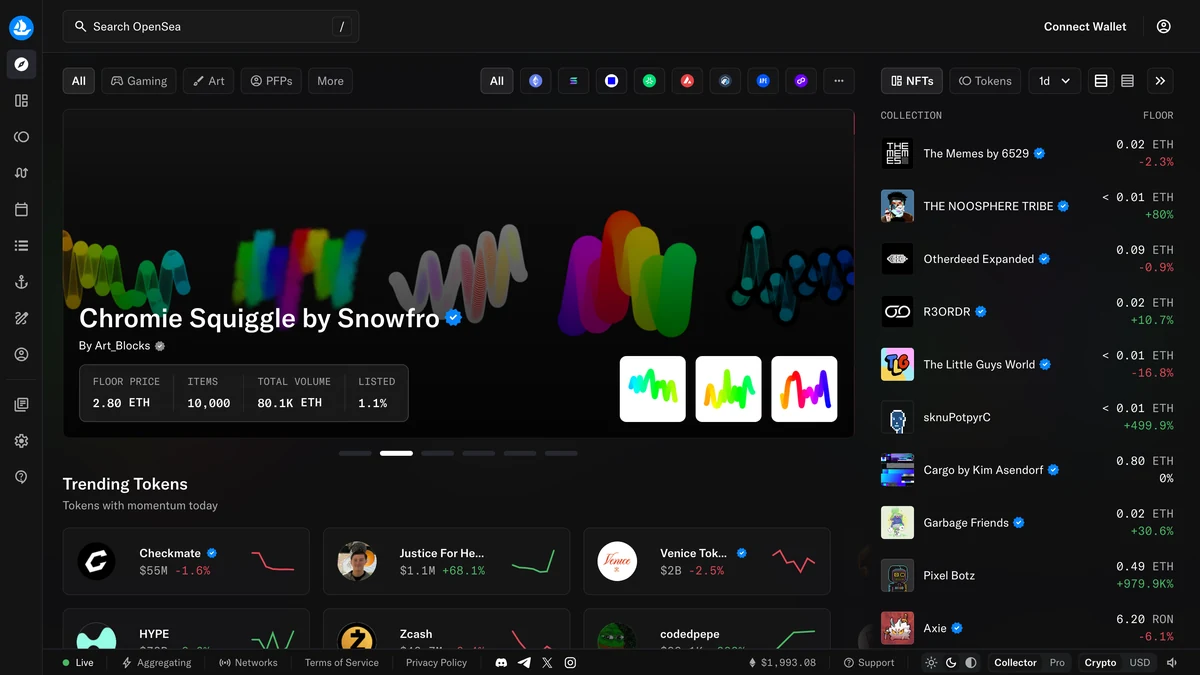
NFTs map differently. Most blue-chip collections, including Bored Ape Yacht Club, CryptoPunks, Pudgy Penguins, and Art Blocks, remain on Ethereum, with OpenSea and Blur as the dominant marketplaces. Solana's NFT market grew rapidly through 2022 around Magic Eden and DeGods, then contracted, then partly recovered around new mint patterns and compressed NFTs that drive per-mint cost below a cent. The marketplace landscape is covered in NFT Marketplaces Compared: Opensea vs Rarible vs Foundation.
Payments are where Solana's low fees and high network throughput show their clearest fit. Solana Pay and USDC on Solana support sub-cent settlement that makes micropayment and point-of-sale rails practical. Ethereum mainnet is not viable for micropayments at current gas fees, but Base, Arbitrum, and Optimism have closed most of that gap with sub-cent costs and seconds-level confirmation. For builders evaluating DeFi protocol depth within the Ethereum ecosystem specifically, the cross-protocol comparison in Uniswap vs Compound vs Aave: A Comprehensive Comparison covers smart contract execution patterns across the three largest money markets.
Choosing Between Ethereum and Solana: A Decision Framework
Ethereum and Solana resolve into a small set of decision criteria once the consensus, throughput, language, reliability, and use-case dimensions are laid side by side. The matrix below collapses the platform-selection decision for a development or operations team into the criterion that usually carries the most weight in each row. (A second reader friction worth surfacing: Ethereum's headline scalability path is not a single product but a layered stack. L2 scaling, danksharding via blob transactions introduced in EIP-4844, and account abstraction together form what most teams now mean by Ethereum scaling, and validator economics flow from the L1 settlement layer up through that stack.)
| Decision Criterion | Choose Ethereum (L1 or L2) | Choose Solana |
|---|---|---|
| Team language expertise | JavaScript, TypeScript, or prior EVM background | Rust, C, or systems programming background |
| Transaction cost sensitivity | Sub-cent on L2; only high-value low-frequency tx on L1 | Sub-cent base fee on every transaction |
| Decentralization requirements | One million validators, low hardware floor | Two thousand validators, high hardware spec |
| Audit tooling maturity | Slither, Mythril, Certora, Foundry, OpenZeppelin | Anchor, Sec3, Neodyme; smaller toolset |
| Uptime and network reliability | No L1 halt post-Merge; L2 sequencer risk remains | Multiple historical halts; QUIC and Firedancer mitigations active |
| DeFi ecosystem depth | Majority of TVL, deepest liquidity | Strong and growing, lower per-tx cost favors HFT-style |
| High-frequency low-value tx | L2 rollups (Base, Arbitrum, Optimism) | Native fit, sub-second confirmation |
The validator economics row deserves a closer look because it drives several of the others. Ethereum's 32 ETH deposit, roughly 3 to 4 percent staking rewards, and one-million-key validator set produce a chain whose security budget scales with ETH price and whose decentralization profile resists hardware-class concentration. Solana's two-thousand-validator set, hardware floor near $5,000 in CPU and memory plus institutional-grade networking, and 6 to 7 percent staking rewards trade decentralization breadth for the latency budget that makes 400-millisecond slots feasible. Neither set of validator economy is wrong; they are tuned for different objectives. Backend services that integrate with either chain through RPC endpoints face a related architectural decision documented in Microservices Communication: gRPC vs REST vs Message Queues, where service-to-service patterns shape how RPC failover and indexer pipelines get built around either chain. For the broader question of when a chain belongs in the architecture at all, the comparison in Blockchain vs Traditional Databases For Enterprises covers the prior decision.
Security-context references that ground the cryptographic primitives and operational baselines both networks rely on: the NIST SP 800-53 Rev 5 control cataloge covers the cryptographic and access-control primitives that anchor every distributed-ledger deployment, the CISA Cross-Sector Cybersecurity Performance Goals set the baseline operational expectations, and the OWASP Application Security Verification Standard covers the application-layer guardrails for dApps on top of either chain.
Further reading
- AI In Finance Applications (hub coverage for the Emerging Technologies finance category)
- Uniswap vs Compound vs Aave: A Comprehensive Comparison (DeFi protocol comparison within the Ethereum ecosystem)
- NFT Marketplaces Compared: Opensea vs Rarible vs Foundation (NFT marketplace landscape across chains)
- Blockchain vs Traditional Databases For Enterprises (when to pick a blockchain over a conventional database)