
Uniswap vs Compound vs Aave is a structured three-protocol comparison that shows how a decentralized exchange, a collateralized lending protocol, and a hybrid lending platform each serve distinct functions within the Ethereum DeFi ecosystem. Treating the three as substitutes obscures what actually differs: Uniswap settles a token swap against pooled inventory, Compound III routes a single base asset between suppliers and borrowers, and Aave runs a multi-asset supply-and-borrow market with flash loan capability. The decision a participant in decentralized finance (DeFi) actually faces is which mechanism fits the operation at hand, not which brand wins.
What Each Protocol Does
Uniswap vs Compound vs Aave maps to three different primitives on Ethereum. Uniswap is an automated market maker (AMM) for spot trading; Compound III is a single-base-asset borrowing market; Aave v3 and v4 operate a multi-asset lending pool with flash loan support. Each is a separate DeFi protocol with its own smart contract surface, governance token, and risk parameters. Reviewing how Ethereum compares to other Layer-1 chains helps explain why all three anchor their primary deployments on Ethereum mainnet, where deep liquidity and validated Ethereum smart contract tooling reduce integration friction.
- Uniswap
- A decentralized exchange (DEX) where users execute a token swap against an AMM liquidity pool rather than an order book. Current production surface spans v2, v3, v4, UniswapX, and the Unichain rollup.
- Compound III
- An EVM compatible protocol where users supply crypto assets as collateral to borrow a single base asset, with USDC as the base on the Ethereum deployment. Compound v2 remains live and uses the older cToken model.
- Aave v3 / v4
- A non-custodial lending market built on a supply-and-borrow model with over-collateralization, a two-slope interest rate model, flash loan primitives, and v4's Hub and Spoke architecture for isolated risk.
How Uniswap Works
Uniswap is the dominant decentralized exchange on Ethereum and runs as an automated market maker (AMM) rather than a matched order book. Anyone executing a token swap trades against a liquidity pool funded by a liquidity provider (LP). Pool depth and the AMM curve set the price; v3 and v4 add concentrated liquidity, letting an LP allocate capital across selected price ranges instead of the full curve. Protocol fees from v2, v3, v4, UniswapX, and Unichain flow into a single onchain collector on each network called the TokenJar, an immutable contract that receives every fee token on that chain and, in the simplest configured path, burns UNI in exchange for the collected tokens. The UNI governance token controls which fee paths and parameters get activated through onchain proposals. How this fits the wider stack is covered in the beginner's guide to blockchain.
- A trader signs a transaction routing a token swap through one or more pools.
- The AMM curve quotes execution price based on pool reserves and the size of the trade.
- A swap fee accrues to the liquidity pool, increasing the value of LP positions.
- A protocol fee fraction routes to the TokenJar contract for the active fee mechanism.
- UNI holders govern fee switches, deployments, and treasury operations onchain.
How Compound Works
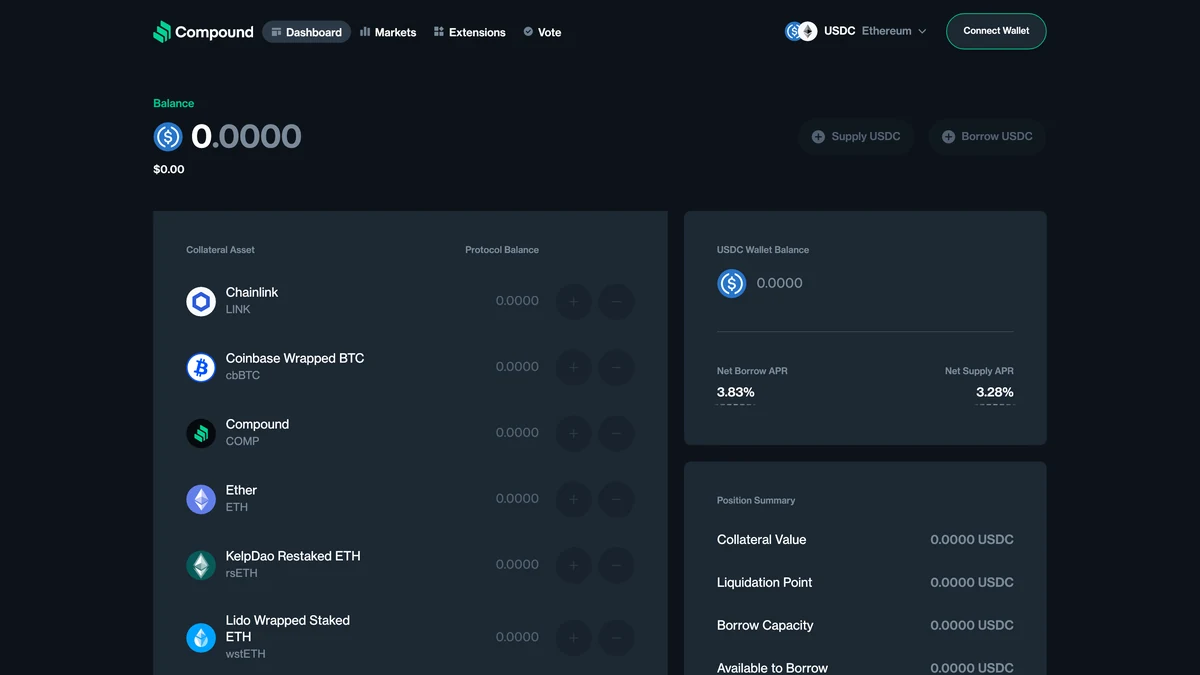
Uniswap vs Compound vs Aave hinges on Compound's split between two live designs. Compound v2 represents each supplied balance as a cToken, an EIP-20 contract whose exchange rate increases relative to the underlying asset as interest accrues. The interest rate model updates whenever a user mints, redeems, borrows, or repays. CErc20 wraps an ERC-20 asset; CEther wraps native Ether. Compound III replaces the multi-asset borrow market with an EVM compatible protocol where users supply crypto assets as collateral but can only borrow the designated base asset. On Ethereum, that base asset is USDC, and suppliers of USDC earn interest while collateral assets do not. The collateral ratio per asset, the utilization rate of the base pool, and the COMP governance token's parameter votes determine borrow capacity and rates. The shift from cToken accounting in v2 to base-asset accounting in III is a material change in risk surface, not a UI refresh.
- Compound v2 cToken
- EIP-20 token whose exchange rate grows as interest accrues; usable as collateral for cross-asset borrowing within the v2 markets.
- Compound III base asset
- The single borrowable asset of a III deployment. On Ethereum mainnet it is USDC; suppliers of USDC earn yield, collateral assets do not.
- COMP governance token
- Controls listing decisions, collateral factors, the interest rate model curve, and treasury operations through onchain votes.
How Aave Works
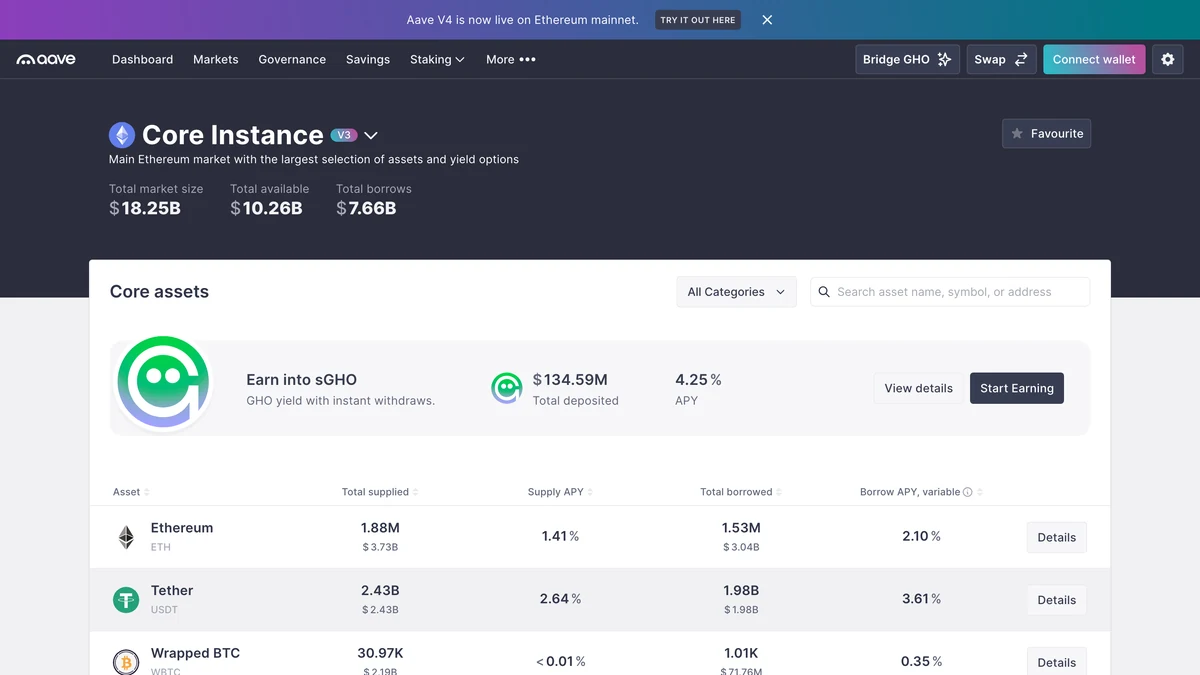
Aave v3 is a non-custodial lending market built on a supply-and-borrow model with over-collateralization, documented across 14+ blockchain networks. Suppliers earn interest, can opt their supplied tokens in as collateral, and borrowers draw against that collateral subject to per-asset risk parameters. The v3 interest rate model uses two slopes anchored to an optimal utilization rate: below the optimum, borrow rates rise gently; above it, they rise steeply to choke off further borrowing and protect liquidity. A user's health factor must stay above 1; once it crosses below, a liquidator can repay a portion of the debt and seize collateral plus a liquidation bonus. Aave also pioneered the flash loan, an uncollateralized borrow that must be repaid inside the same transaction or the entire transaction reverts. Aave v4 reshapes liquidity around a Hub and Spoke architecture: the Liquidity Hub consolidates protocol-wide liquidity and accounting while Spokes implement modular borrowing with isolated risk. Where v3 tracks positions per-market, v4 tracks them per-Spoke, so a user can isolate strategies under the AAVE governance token's parameter regime.
- A supplier deposits an asset and receives an interest-bearing receipt token.
- The supplier optionally enables the asset as collateral, which sets a collateral ratio cap.
- A borrower draws a different asset against that collateral, subject to the health factor.
- Interest accrues continuously according to the two-slope interest rate curve and live utilization rate.
- If the health factor falls below 1, an automated liquidator repays debt and claims the liquidation bonus.
- A flash loan can be opened and closed atomically in the same transaction for arbitrage or refinancing.
Protocol Comparison: Key Differences
Uniswap vs Compound vs Aave sit on a single axis only at the brand level. Functionally, they split along primary purpose (token swap vs single-asset borrow vs multi-asset lending), fee mechanics, collateral demand, chain coverage, and governance token role. The table below summarizes how a decentralized exchange diverges from a base-asset borrowing market and from a multi-asset lending pool with flash loan support. Production deployment patterns are covered in enterprise blockchain in production.
| Protocol | Primary Function | Fee Model | Collateral Requirement | Chain Coverage | Governance Token |
|---|---|---|---|---|---|
| Uniswap (v2/v3/v4, UniswapX, Unichain) | AMM-based token swap on a DEX | Swap fee to LPs; protocol fee routed to TokenJar collector | None for swaps; LP capital backs each liquidity pool | Ethereum and multiple EVM networks plus Unichain rollup | UNI |
| Compound III | Borrow a single base asset against pledged collateral | Interest spread between base-asset borrow and supply rates | Over-collateralization per-asset with a collateral factor; only base asset earns yield | Ethereum (USDC base) plus additional EVM deployments | COMP |
| Aave v3 / v4 | Multi-asset supply-and-borrow with flash loan support | Two-slope interest rate curve; reserve factor accrues to protocol | Over-collateralization with a per-asset collateral ratio; health factor must exceed 1 | 14+ networks (v3); Hub and Spoke deployments (v4) | AAVE |
Three takeaways follow from the comparison. First, only Uniswap settles trades against a liquidity pool without a credit relationship, so the exchange carries no liquidation surface but does expose the liquidity provider to inventory risk. Second, Compound III narrows collateral to a single borrowable base asset, which simplifies the rate model and risk graph but removes cross-asset borrowing flexibility. Third, Aave's flash loan and multi-asset markets layer the most surface area for composability, which is why most onchain arbitrage and refinancing flows route through Aave smart contract calls. Federal Reserve research on DeFi market structure documents how these distinct primitives interact in practice (Federal Reserve Bank of St. Louis Review).
Risks and Limitations
Uniswap vs Compound vs Aave share an obvious common risk and several that are protocol-specific. Every contract surface is subject to smart contract exploit risk; an audit reduces but does not eliminate it. Beyond code risk, each protocol carries distinct operational hazards. Foundational background on the underlying blockchain trust model appears in NIST Internal Report 8202, and peer-reviewed analysis of AMM-specific mechanics appears in this IEEE survey on automated market maker design.
- Impermanent loss (Uniswap LPs). When relative prices in a pool diverge from deposit ratios, an LP holds less of the appreciating asset than if they had simply held both tokens outside the pool.
- Liquidation cascades (Compound and Aave). If a borrower's collateral ratio falls past the per-asset threshold or the Aave health factor drops below 1, a liquidator repays debt and seizes collateral with a liquidation bonus. The action is automated by smart contract and cannot be reversed.
- Utilization rate spikes. A sudden surge in borrow demand can push the utilization rate beyond the optimum and lock suppliers out of withdrawals until rates re-balance the pool.
- Oracle manipulation. All three protocols depend on price oracles for collateral valuation and swap routing; a manipulated feed can trigger wrongful liquidations or unfavorable swap pricing.
- Governance capture. Concentrated holdings of the governance token can shift fee parameters, collateral lists, or the interest rate curves in ways that disadvantage other users.
- Over-collateralization drag. Borrowing requires posting more value than is borrowed, which caps capital efficiency relative to traditional credit.
Which Protocol to Use
Uniswap vs Compound vs Aave resolves cleanly once the user's intended action is named. The following framework maps each common DeFi protocol task to the right venue. For broader architectural context on choosing onchain over traditional infrastructure, see blockchain versus traditional databases for enterprises.
- Execute a one-off token swap. Use Uniswap. The DEX routes through the deepest liquidity pool on the chosen network and requires only a connected wallet.
- Earn yield on stablecoin holdings with minimal complexity. Supply USDC to Compound III on Ethereum. The single base asset model keeps the collateral ratio surface narrow and the rate curve legible.
- Borrow against a diverse collateral basket. Use Aave v3 or v4. Multi-asset collateral, the two-slope interest rate model, and per-Spoke isolation in v4 give the broadest set of borrowing strategies.
- Run flash loan arbitrage or atomic refinancing. Use Aave. The flash loan is native to Aave smart contract design; Compound does not offer it, and Uniswap's flash swap is narrower in scope.
- Provide liquidity for fee income. Become a liquidity provider on a Uniswap pool, accepting impermanent loss exposure in exchange for swap fees and any protocol-level rewards from the UNI governance token treasury.
- Influence protocol direction. Acquire the relevant governance token (UNI, COMP, or AAVE) and vote on listings, fee switches, and risk parameters specific to that protocol.
Further reading
Frequently Asked Questions
Which DeFi protocol is best for beginners?
Uniswap is the most accessible starting point for new DeFi participants because the swaps require only a connected wallet and no active collateral management. Compound and Aave both require users to understand collateral ratios, liquidation thresholds, and the collateral cushions before borrowing, which adds meaningful operational risk for users unfamiliar with over-collateralization mechanics.
What happens if my Aave health factor drops below 1?
When the Aave health factor falls below 1, a liquidator can repay a portion of the outstanding debt and receive the borrower's collateral plus a liquidation bonus. This process is automated by smart contract and does not require the borrower's action, meaning the collateral loss is immediate and cannot be reversed once triggered.
Can Uniswap, Compound, and Aave be used at the same time?
Yes, they operate as independent smart contract protocols and a single Ethereum wallet can interact with all three simultaneously. A common pattern is to supply collateral to Aave to borrow a stablecoin, then use that stablecoin to provide liquidity on Uniswap, though this compounds exposure to liquidation risk, impermanent loss, and the contract vulnerabilities across two protocols at once.
What are flash loans and which protocol offers them?
Flash loans are uncollateralized loans that must be borrowed and repaid within a single Ethereum transaction block, reverting the entire transaction if repayment fails. Aave introduced this mechanism and remains the primary provider; Uniswap supports a related feature called flash swaps, but Compound does not offer flash loan functionality.