A crypto wallet is a software or hardware tool that stores the signing keys needed to authorize blockchain transactions. The wallet itself holds no coins; the assets live on the blockchain ledger, and the wallet's private key is the only credential that can move them. That distinction between key custody and asset custody defines every security tradeoff practitioners encounter when deploying cryptocurrency infrastructure.
What a Crypto Wallet Actually Stores
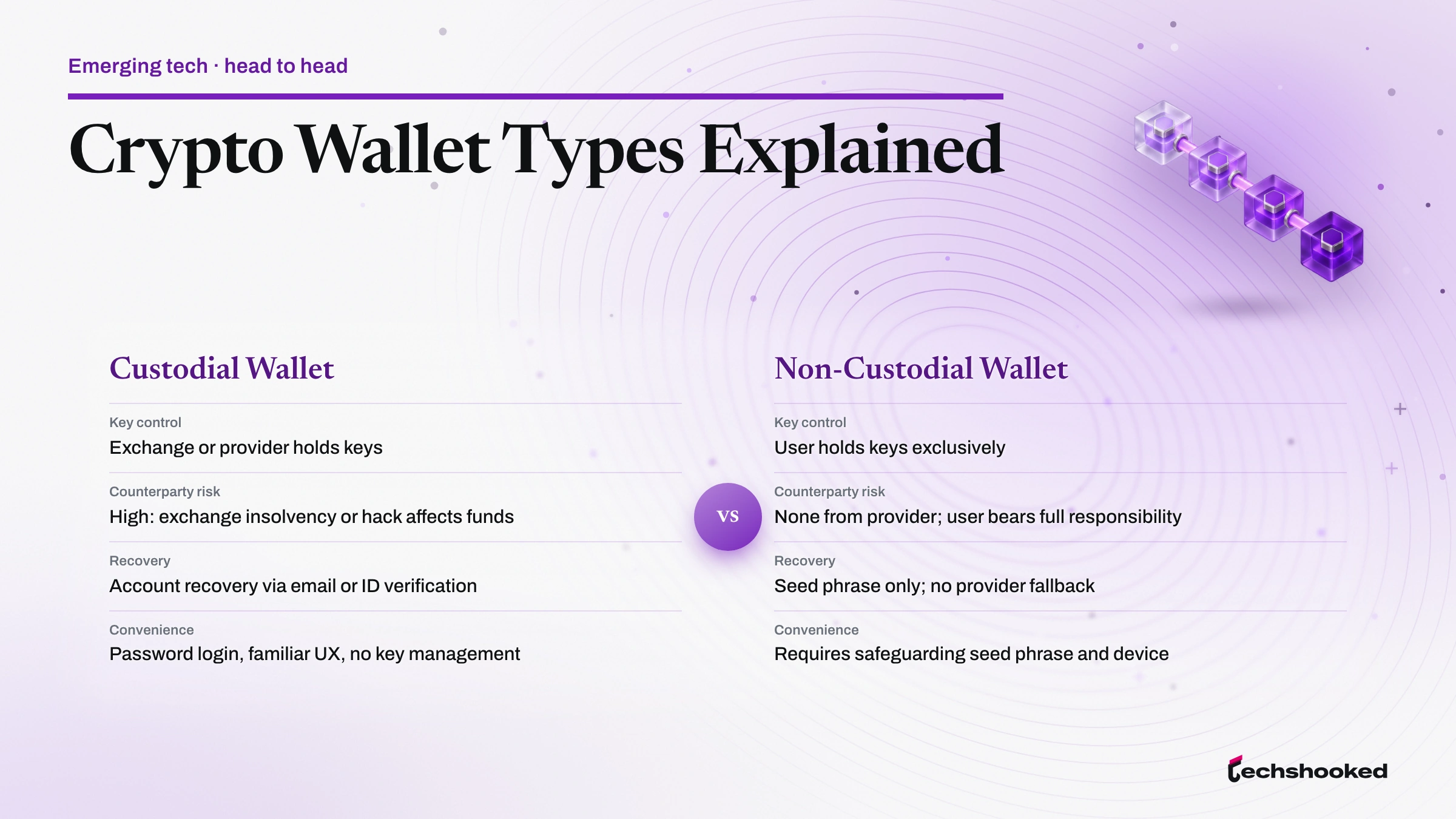
The fundamental custody question for any crypto wallet is who holds the private key. Custodial wallet services, such as centralized exchange accounts, retain the signing keys on the user's behalf. Non-custodial wallet software gives the user sole control, meaning the provider never touches the key material at any point.
| Dimension | Custodial Wallet | Non-Custodial Wallet |
|---|---|---|
| Key control | Exchange or provider holds keys | User holds keys exclusively |
| Counterparty risk | High: exchange insolvency or hack affects funds | None from provider; user bears full responsibility |
| Recovery | Account recovery via email or ID verification | Seed phrase only; no provider fallback |
| Convenience | Password login, familiar UX, no key management | Requires safeguarding seed phrase and device |
| Regulatory exposure | Subject to KYC/AML rules and account freezes | Permissionless; user manages compliance obligations |
| Typical users | Beginners, frequent traders on exchanges | Self-custody advocates, DeFi participants |
The counterparty risk differential is concrete. When an exchange holding custodial wallet funds files for insolvency, users may lose access to assets while legal proceedings resolve. A non-custodial wallet eliminates that vector entirely: the blockchain transaction can only be authorized by the key the user controls. The tradeoff is that there is no account-recovery mechanism if the seed phrase is lost.
Hot Wallets vs Cold Storage
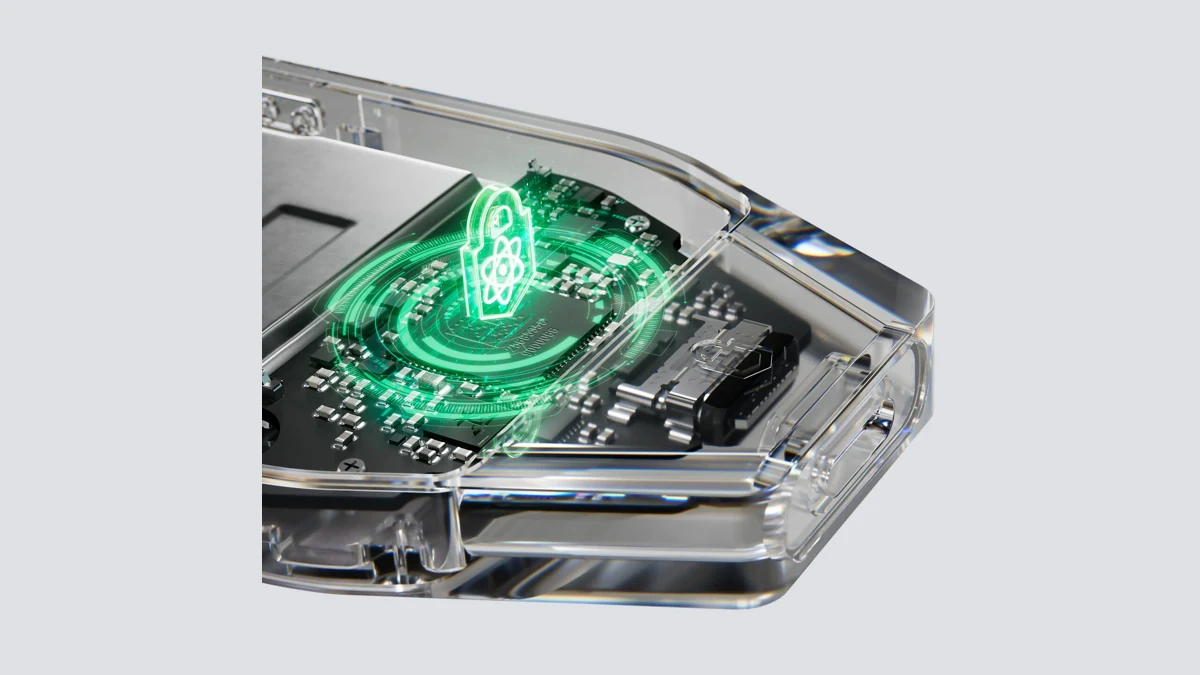
A crypto wallet connected to the internet is a hot wallet; one that keeps its signing key on an air-gapped device is cold storage. The connectivity distinction maps directly to attack surface. Hot wallets enable fast, convenient access for frequent blockchain transactions but expose private keys to malware, phishing, and browser-based exploits on internet-connected devices.
| Dimension | Hot Wallet | Cold Storage / Hardware Wallet |
|---|---|---|
| Key location | Stored on internet-connected device | Stored in isolated hardware chip |
| Signing method | Online, inside the application | Offline signing on the device itself |
| Remote-attack risk | High: keys reachable by malware or exploits | Low: key material never leaves the device |
| Access speed | Immediate; browser or mobile app | Requires physical device present |
| Typical use | Daily transactions, DApp interactions | Long-term storage, large holdings |
Hardware wallet devices, such as those from Ledger, keep the private key inside a secure element chip. The device performs offline signing locally, then passes only the signed transaction output to the connected computer for broadcast. The secret never leaves the hardware chip, even during an active blockchain transaction. Ledger's documentation on how hardware wallets sign transactions with an offline private key details the signing flow. Cold storage is most practical for holdings that are accessed infrequently, where the friction of physical access is an acceptable tradeoff for stronger isolation.
Seed Phrases and Private Key Security
Every crypto wallet that gives users direct key control generates a seed phrase at setup: a sequence of 12 or 24 common English words encoding the wallet's master signing key using the BIP-39 derivation standard. From that single seed phrase, the wallet derives all child keys and public addresses in the hierarchy, so the seed phrase is the ultimate single point of recovery and failure. Long-term threats to seed phrase security now include advances in quantum computing; the post-quantum cryptography threats to key security article covers the trajectory of that risk.
Protecting a private key and its seed phrase requires disciplined physical and operational security practices:
- Write the seed phrase on paper or metal at wallet creation. Never store it in a photo, cloud note, password manager, or email draft. Physical media cannot be remotely exfiltrated.
- Store multiple copies in separate physical locations. A single copy destroyed in a fire or flood is unrecoverable. Fireproof metal seed-phrase plates add durability without adding digital exposure.
- Never enter the seed phrase into any website or application unless restoring into a verified, offline wallet application. Phishing sites impersonate wallet interfaces to harvest seed phrases.
- Use a passphrase extension (BIP-39 optional passphrase) for high-value wallets. This adds a user-defined word on top of the seed phrase, creating a separate wallet derivation that requires both components to access.
- Rotate exposure after any suspected compromise. If a device holding a hot wallet is infected with malware, move assets to a new wallet with fresh key material before the attacker can act.
AI-Agent Wallets and Programmable Custody
An agentic wallet is a crypto wallet controlled programmatically by an AI agent rather than a human operator. The architecture separates transaction authorization from human interaction: the AI agent calls a wallet API, constructs a blockchain transaction, and signs it autonomously according to policy rules. Coinbase's Developer Platform introduced an Agentic Wallets product specifically designed for this pattern, providing agents with on-chain identity and programmable spend guardrails. The Agentic Wallets launch documentation describes the authorization model and the Base network integration. Developer reference documentation is available at the Coinbase CDP agentic wallet documentation.
The security architecture for agentic wallets relies on multi-party computation (MPC), a cryptographic protocol where the private key is split into shards held by separate parties, so no single party ever possesses the complete credential. MPC eliminates the single-point-of-failure present in traditional key files and enables threshold-signing policies, where a blockchain transaction requires approval from M of N keyholders. For agentic wallets, spend guardrails encode limits directly into the signing policy: maximum transaction value, permitted destination addresses, allowed token types, and rate limits per time window. The Web3 ownership model and decentralized finance article provides context on the decentralized infrastructure agentic wallets operate within.
Agentic wallet infrastructure on Base (Coinbase's Ethereum layer-2 network) enables AI agents to pay for decentralized application services, hold and transfer tokens, and execute smart contract interactions without human confirmation at each step. The risk profile differs from human-controlled wallets: automated agents can execute high transaction volume rapidly, so spend guardrails and revocable API keys are essential operational controls rather than optional hardening.
- Define spend guardrails before deploying any agentic wallet. Set per-transaction maximums, daily limits, and allowlisted destination addresses in the signing policy. Unbounded agent wallets are a high-risk configuration.
- Use MPC key management instead of a key file. Distributing key shards across independent infrastructure prevents a single server compromise from exposing the full credential.
- Implement audit logging for every signed transaction. Autonomous agents generate transaction volume that requires automated anomaly detection to spot policy violations or compromised agent behavior.
- Scope API permissions narrowly. Grant agents only the token types and contract addresses their task requires. Over-permissioned agentic wallets expand blast radius if an agent is manipulated via prompt injection or adversarial inputs.
How to Choose the Right Wallet for Your Use Case
Selecting a crypto wallet type depends on transaction frequency, asset value, and whether self-custody is the priority. For users interacting daily with a decentralized application (DApp), a browser-extension hot wallet balances accessibility with direct key control. For long-term holdings not accessed frequently, cold storage in a hardware wallet removes the remote-attack surface almost entirely. Patterns for interacting with Ethereum smart contracts through wallet connections are covered in the interacting with Ethereum smart contracts guide.
MetaMask's extensibility model, including the Snaps framework described in MetaMask's FoxTagger Snap documentation, illustrates how hot wallet software can extend functionality for DApp use cases while keeping the signing key on the user's device. That breadth of integration comes with the connectivity tradeoffs of any hot wallet.
A practical decision framework by use case:
- Frequent DApp interaction or trading: A non-custodial hot wallet provides direct key control and fast blockchain transaction signing. Keep only the amount needed for active use; move larger balances to cold storage.
- Long-term storage of significant asset value: A hardware wallet with offline signing is the appropriate architecture. Set up cold storage before moving funds; the device generates its own private key in an air-gapped environment.
- Beginner or low-frequency use: A custodial wallet on a regulated exchange reduces key management complexity. The counterparty risk is real but bounded by choosing exchanges with proof-of-reserves and regulatory standing.
- AI agent or automated system: An agentic wallet with MPC key management and encoded spend guardrails provides programmable self-custody for non-human operators.
- High-security personal custody: A non-custodial hardware wallet combined with a BIP-39 passphrase extension and geographically distributed seed phrase backups represents the most resilient self-custody configuration for individual users.
Wallet type selection is not permanent. Many practitioners use a layered approach: a hot wallet for active use, a hardware wallet for bulk storage, and a custodial account for fiat on-ramp access. The architecture scales with the value at stake and the transaction patterns of the specific use case.
Further reading
- Coinbase Agentic Wallets product page (coinbase.com)
- Coinbase CDP Agentic Wallet documentation (docs.cdp.coinbase.com)
- Ledger Academy: offline signing with a hardware wallet (ledger.com)
- MetaMask FoxTagger Snap: address tagging extensibility (metamask.io)
- Coinbase Agentic Wallets launch overview (coinbase.com)
- How To Create an Ethereum Smart Contract: A Developer Guide
- How To Implement AI In Healthcare: HIPAA, FDA SaMD, and a 7-Step Clinical Deployment Guide
- How to Choose an AR SDK: ARKit vs ARCore vs AR Foundation
Frequently Asked Questions
What is the difference between a custodial and non-custodial crypto wallet?
A custodial wallet holds your private keys on your behalf, meaning a third-party service controls access to your funds. A non-custodial wallet gives you sole control of your private keys so only you can authorize transactions. For most users, non-custodial wallets are recommended because they eliminate counterparty risk, though they require you to safeguard your own seed phrase.
What is a seed phrase and why does it matter?
A seed phrase is a human-readable backup of your wallet private key, typically 12 or 24 randomly generated words. Anyone who obtains your seed phrase can restore your wallet on any compatible device and transfer all your funds. Store it offline in a physically secure location; never photograph it or save it to a cloud service.
Are hardware wallets safer than software wallets?
Hardware wallets sign transactions offline so your private key never touches an internet-connected device, making them resistant to remote attacks. Software wallets are more convenient for frequent transactions but are exposed to malware and phishing if your device is compromised. The right choice depends on your transaction frequency and the value of assets you hold.